


Page 242 - Low Temperature Energy Systems with Applications of Renewable Energy
P. 242
Geothermal energy in combined heat and power systems              229


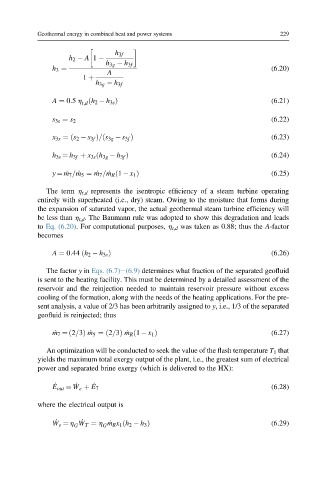
                                h 3f
                    h 2   A 1
                              h 3g   h 3f
               h 3 ¼                                                      (6.20)
                              A
                       1 þ
                           h 3g   h 3f
               A ¼ 0:5 h ðh 2   h 3s Þ                                    (6.21)
                       t;d
                                                                          (6.22)
               s 3s ¼ s 2
               x 3s ¼ðs 2   s 3f Þ=ðs 3g   s 3f Þ                         (6.23)

               h 3s ¼ h 3f þ x 3s ðh 3g   h 3f Þ                          (6.24)

               y ¼ _ m 7= _ m 5 ¼ _ m 7= _ m R ð1   x 1 Þ                 (6.25)

              The term h t,d represents the isentropic efficiency of a steam turbine operating
           entirely with superheated (i.e., dry) steam. Owing to the moisture that forms during
           the expansion of saturated vapor, the actual geothermal steam turbine efficiency will
           be less than h t,d . The Baumann rule was adopted to show this degradation and leads
           to Eq. (6.20). For computational purposes, h t,d was taken as 0.88; thus the A-factor
           becomes

               A ¼ 0:44 ðh 2   h 3s Þ                                     (6.26)

              The factor y in Eqs. (6.7)e(6.9) determines what fraction of the separated geofluid
           is sent to the heating facility. This must be determined by a detailed assessment of the
           reservoir and the reinjection needed to maintain reservoir pressure without excess
           cooling of the formation, along with the needs of the heating applications. For the pre-
           sent analysis, a value of 2/3 has been arbitrarily assigned to y, i.e., 1/3 of the separated
           geofluid is reinjected; thus

                _ m 7 ¼ð2=3Þ _ m 5 ¼ð2=3Þ _ m R ð1   x 1 Þ                (6.27)

              An optimization will be conducted to seek the value of the flash temperature T 1 that
           yields the maximum total exergy output of the plant, i.e., the greatest sum of electrical
           power and separated brine exergy (which is delivered to the HX):
                _     _   _
               E out ¼ W e þ E 7                                          (6.28)

           where the electrical output is

                _      _
               W e ¼ h W T ¼ h _ m R x 1 ðh 2   h 3 Þ                     (6.29)
                     G       G

