


Page 243 - Low Temperature Energy Systems with Applications of Renewable Energy
P. 243
230                 Low-Temperature Energy Systems with Applications of Renewable Energy

            Several additional assumptions were made to facilitate the calculations:

          1. Pressure losses in piping are neglected.
          2. All plant components are perfectly insulated.
          3. Pure water is used to model the geothermal fluid.
          4. All liquid state points are assumed saturated.
          5. Refprop [2] was used to determine the thermodynamic properties of water.
          6. Generator efficiency is 0.975.

          7. Reservoir temperature is 220 C.

          8. Condenser temperature is 40 C.
          9. Geofluid total mass flow at wellheads is 350 kg/s.
         10. Dead state: 20 C and 0.10 MPa.

         11. Monetary value of electricity is 0.10 US$/kWh.
         12. Monetary value of heat exergy sent to the HX is 0.10   H US$/kWh, where 0   H   1.
            An Excel spreadsheet was written to simulate the processes of the plant with
         Refprop as an “add-in” and calculations were performed for the range of flash tem-

         peratures from 120 C to 180 Cto find the optimum thermodynamic operating

         point. If the exergy associated with the two energy outputs from the plant (the elec-
         tricity and the brine heat sent to the HX) is optimized thermodynamically, then the
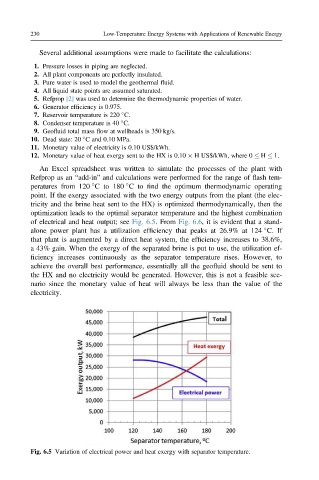
         optimization leads to the optimal separator temperature and the highest combination
         of electrical and heat output; see Fig. 6.5. From Fig. 6.6, it is evident that a stand-

         alone power plant has a utilization efficiency that peaks at 26.9% at 124 C. If
         that plant is augmented by a direct heat system, the efficiency increases to 38.6%,
         a 43% gain. When the exergy of the separated brine is put to use, the utilization ef-
         ficiency increases continuously as the separator temperature rises. However, to
         achieve the overall best performance, essentially all the geofluid should be sent to
         the HX and no electricity would be generated. However, this is not a feasible sce-
         nario since the monetary value of heat will always be less than the value of the
         electricity.


         Fig. 6.5 Variation of electrical power and heat exergy with separator temperature.

