


Page 258 - Low Temperature Energy Systems with Applications of Renewable Energy
P. 258
244 Low-Temperature Energy Systems with Applications of Renewable Energy
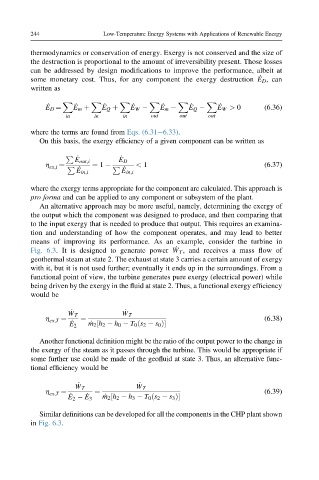
thermodynamics or conservation of energy. Exergy is not conserved and the size of
the destruction is proportional to the amount of irreversibility present. Those losses
can be addressed by design modifications to improve the performance, albeit at
_
some monetary cost. Thus, for any component the exergy destruction E D ,can
written as
_ X _ X _ X _ X _ X _ X _
E D ¼ E m þ E Q þ E W E m E Q E W > 0 (6.36)
in in in out out out
where the terms are found from Eqs. (6.31e6.33).
On this basis, the exergy efficiency of a given component can be written as
_ _
P
E out;i E D
h < 1 (6.37)
ex;i ¼ P _ ¼ 1 P _
E in;i E in;i
where the exergy terms appropriate for the component are calculated. This approach is
pro forma and can be applied to any component or subsystem of the plant.
An alternative approach may be more useful, namely, determining the exergy of
the output which the component was designed to produce, and then comparing that
to the input exergy that is needed to produce that output. This requires an examina-
tion and understanding of how the component operates, and may lead to better
means of improving its performance. As an example, consider the turbine in
_
Fig. 6.3. It is designed to generate power W T , and receives a mass flow of
geothermal steam at state 2. The exhaust at state 3 carries a certain amount of exergy
with it, but it is not used further; eventually it ends up in the surroundings. From a
functional point of view, the turbine generates pure exergy (electrical power) while
beingdrivenbythe exergyin the fluid at state 2. Thus, a functional exergy efficiency
would be
_ _
W T W T
h ex;T ¼ ¼ (6.38)
_
E 2 _ m 2 ½h 2 h 0 T 0 ðs 2 s 0 Þ
Another functional definition might be the ratio of the output power to the change in
the exergy of the steam as it passes through the turbine. This would be appropriate if
some further use could be made of the geofluid at state 3. Thus, an alternative func-
tional efficiency would be
_ _
W T W T
h ¼ ¼ (6.39)
ex;T _ _
E 2 E 3 _ m 2 ½h 2 h 3 T 0 ðs 2 s 3 Þ
Similar definitions can be developed for all the components in the CHP plant shown
in Fig. 6.3.

