


Page 272 - Low Temperature Energy Systems with Applications of Renewable Energy
P. 272
Geothermal energy in combined heat and power systems              257

           4. With reference to Table 6.1, which of the fluids listed there would be technically feasible can-
              didates for a bottoming supercritical binary cycle power plant, if waste brine from a flash
              plant was available at a temperature of 140 C? Explain your rationale.


           Exercises

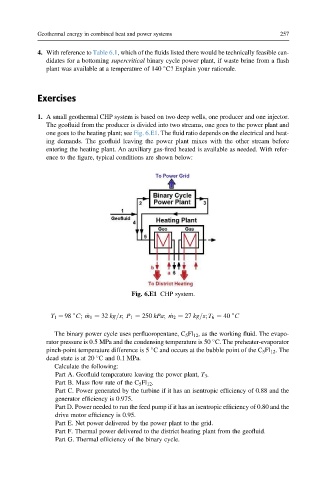
           1. A small geothermal CHP system is based on two deep wells, one producer and one injector.
              The geofluid from the producer is divided into two streams, one goes to the power plant and
              one goes to the heating plant; see Fig. 6.E1. The fluid ratio depends on the electrical and heat-
              ing demands. The geofluid leaving the power plant mixes with the other stream before
              entering the heating plant. An auxiliary gas-fired heated is available as needed. With refer-
              ence to the figure, typical conditions are shown below:


                                     Fig. 6.E1 CHP system.


               T 1 ¼ 98 C; _ m 1 ¼ 32 kg=s; P 1 ¼ 250 kPa; _ m 2 ¼ 27 kg=s; T 6 ¼ 40 C

                The binary power cycle uses perfluoropentane, C 5 Fl 12 , as the working fluid. The evapo-

              rator pressure is 0.5 MPa and the condensing temperature is 50 C. The preheater-evaporator
              pinch-point temperature difference is 5 C and occurs at the bubble point of the C 5 Fl 12 . The

              dead state is at 20 C and 0.1 MPa.

                Calculate the following:
                Part A. Geofluid temperature leaving the power plant, T 3 .
                Part B. Mass flow rate of the C 5 Fl 12 .
                Part C. Power generated by the turbine if it has an isentropic efficiency of 0.88 and the
                generator efficiency is 0.975.
                Part D. Power needed to run the feed pump if it has an isentropic efficiency of 0.80 and the
                drive motor efficiency is 0.95.
                Part E. Net power delivered by the power plant to the grid.
                Part F. Thermal power delivered to the district heating plant from the geofluid.
                Part G. Thermal efficiency of the binary cycle.

