


Page 225 - Machine Learning for Subsurface Characterization
P. 225
Deep neural network architectures Chapter  7 195


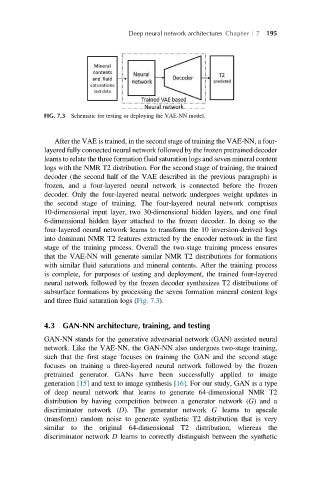
             FIG. 7.3 Schematic for testing or deploying the VAE-NN model.


                After the VAE is trained, in the second stage of training the VAE-NN, a four-
             layered fully connected neural network followed by the frozen pretrained decoder
             learns to relate the three formation fluid saturation logs and seven mineral content
             logs with the NMR T2 distribution. For the second stage of training, the trained
             decoder (the second half of the VAE described in the previous paragraph) is
             frozen, and a four-layered neural network is connected before the frozen
             decoder. Only the four-layered neural network undergoes weight updates in
             the second stage of training. The four-layered neural network comprises
             10-dimensional input layer, two 30-dimensional hidden layers, and one final
             6-dimensional hidden layer attached to the frozen decoder. In doing so the
             four-layered neural network learns to transform the 10 inversion-derived logs
             into dominant NMR T2 features extracted by the encoder network in the first
             stage of the training process. Overall the two-stage training process ensures
             that the VAE-NN will generate similar NMR T2 distributions for formations
             with similar fluid saturations and mineral contents. After the training process
             is complete, for purposes of testing and deployment, the trained four-layered
             neural network followed by the frozen decoder synthesizes T2 distributions of
             subsurface formations by processing the seven formation mineral content logs
             and three fluid saturation logs (Fig. 7.3).


             4.3 GAN-NN architecture, training, and testing

             GAN-NN stands for the generative adversarial network (GAN) assisted neural
             network. Like the VAE-NN, the GAN-NN also undergoes two-stage training,
             such that the first stage focuses on training the GAN and the second stage
             focuses on training a three-layered neural network followed by the frozen
             pretrained generator. GANs have been successfully applied to image
             generation [15] and text to image synthesis [16]. For our study, GAN is a type
             of deep neural network that learns to generate 64-dimensional NMR T2
             distribution by having competition between a generator network (G)and a
             discriminator network (D). The generator network G learns to upscale
             (transform) random noise to generate synthetic T2 distribution that is very
             similar to the original 64-dimensional T2 distribution, whereas the
             discriminator network D learns to correctly distinguish between the synthetic

