


Page 320 - Machine Learning for Subsurface Characterization
P. 320
280 Machine learning for subsurface characterization


              0.100                           0.100
              0.075                           0.075
              0.050                           0.050
              0.025                           0.025
              0.000                           0.000
                1  2  3  4  5  6  7  8  9  10   1  2  3  4  5  6  7  8  9  10
               0                     10         0                    10
               15                    11        15                    11
               30                    12        30                    12
               45                    13        45                    13
               60                              60
                                     14                              14
               75                              75
                                     15                              15
               90                              90
                                     16                              16
              105                             105
                           Sensors   17                     Sensors  17
              120                             120
                           Source                           Source
              135                    18       135                    18
              150                    28       150                    28
                0  15  30  45  60  75  90  105  120  135  150  0.00  0.05  0.10  0  15  30  45  60  75  90  105  120  135  150  0.00  0.05  0.10
              0.000                  Importance  0.000               Importance
              0.025                           0.025
              0.050                           0.050
              0.075                           0.075
              0.100                           0.100
                19  20  21  22  23  24  25  26  27  28  19  20  21  22  23  24  25  26  27  28
                      Sensor index                    Sensor index
             (A)                             (B)
              0.100                           0.100
              0.075                           0.075
              0.050                           0.050
              0.025                           0.025
              0.000                           0.000
                1  2  3  4  5  6  7  8  9  10   1  2  3  4  5  6  7  8  9  10
               0                     10         0                    10
               15                    11        15                    11
               30                    12        30                    12
               45                    13        45                    13
               60                              60
                                     14                              14
               75                              75
                                     15                              15
               90                              90
                                     16                              16
              105                             105
                           Sensors   17                    Sensors   17
              120                             120
                           Source                          Source
              135                    18       135                    18
              150                    28       150                    28
                0  15  30  45  60  75  90  105  120  135  150  0.00  0.05  0.10  0  15  30  45  60  75  90  105  120  135  150  0.00  0.05  0.10
              0.000                  Importance  0.000               Importance
              0.025                           0.025
              0.050                           0.050
              0.075                           0.075
              0.100                           0.100
                19  20  21  22  23  24  25  26  27  28  19  20  21  22  23  24  25  26  27  28
                      Sensor index                    Sensor index
             (C)                             (D)
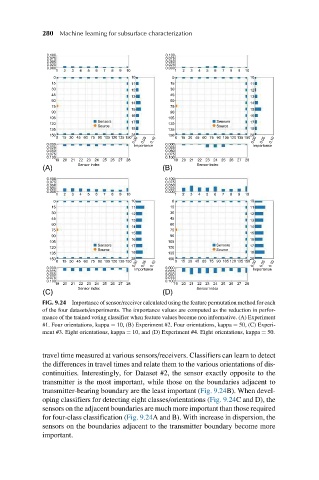
            FIG. 9.24 Importance of sensor/receiver calculated using the feature permutation method for each
            of the four datasets/experiments. The importance values are computed as the reduction in perfor-
            mance of the trained voting classifier when feature values become non informative. (A) Experiment
            #1. Four orientations, kappa ¼ 10, (B) Experiment #2. Four orientations, kappa ¼ 50, (C) Experi-
            ment #3. Eight orientations, kappa ¼ 10, and (D) Experiment #4. Eight orientations, kappa ¼ 50.
            travel time measured at various sensors/receivers. Classifiers can learn to detect
            the differences in travel times and relate them to the various orientations of dis-
            continuities. Interestingly, for Dataset #2, the sensor exactly opposite to the
            transmitter is the most important, while those on the boundaries adjacent to
            transmitter-bearing boundary are the least important (Fig. 9.24B). When devel-
            oping classifiers for detecting eight classes/orientations (Fig. 9.24C and D), the
            sensors on the adjacent boundaries are much more important than those required
            for four-class classification (Fig. 9.24A and B). With increase in dispersion, the
            sensors on the boundaries adjacent to the transmitter boundary become more
            important.

