


Page 315 - Machine Learning for Subsurface Characterization
P. 315
276 Machine learning for subsurface characterization


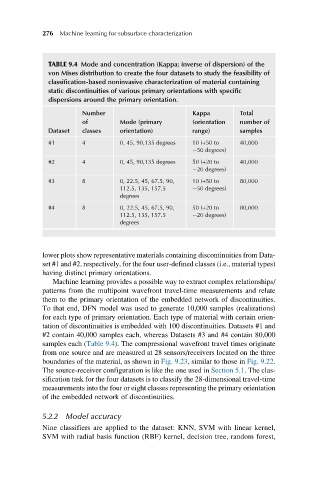
              TABLE 9.4 Mode and concentration (Kappa; inverse of dispersion) of the
              von Mises distribution to create the four datasets to study the feasibility of
              classification-based noninvasive characterization of material containing
              static discontinuities of various primary orientations with specific
              dispersions around the primary orientation.

                       Number                        Kappa        Total
                       of        Mode (primary       (orientation  number of
              Dataset  classes   orientation)        range)       samples
              #1       4         0, 45, 90,135 degrees  10 (+50 to  40,000
                                                      50 degrees)
              #2       4         0, 45, 90,135 degrees  50 (+20 to  40,000
                                                      20 degrees)
              #3       8         0, 22.5, 45, 67.5, 90,  10 (+50 to  80,000
                                 112.5, 135, 157.5    50 degrees)
                                 degrees
              #4       8         0, 22.5, 45, 67.5, 90,  50 (+20 to  80,000
                                 112.5, 135, 157.5    20 degrees)
                                 degrees


            lower plots show representative materials containing discontinuities from Data-
            set #1 and #2, respectively, for the four user-defined classes (i.e., material types)
            having distinct primary orientations.
               Machine learning provides a possible way to extract complex relationships/
            patterns from the multipoint wavefront travel-time measurements and relate
            them to the primary orientation of the embedded network of discontinuities.
            To that end, DFN model was used to generate 10,000 samples (realizations)
            for each type of primary orientation. Each type of material with certain orien-
            tation of discontinuities is embedded with 100 discontinuities. Datasets #1 and
            #2 contain 40,000 samples each, whereas Datasets #3 and #4 contain 80,000
            samples each (Table 9.4). The compressional wavefront travel times originate
            from one source and are measured at 28 sensors/receivers located on the three
            boundaries of the material, as shown in Fig. 9.23, similar to those in Fig. 9.22.
            The source-receiver configuration is like the one used in Section 5.1. The clas-
            sification task for the four datasets is to classify the 28-dimensional travel-time
            measurements into the four or eight classes representing the primary orientation
            of the embedded network of discontinuities.


            5.2.2 Model accuracy
            Nine classifiers are applied to the dataset: KNN, SVM with linear kernel,
            SVM with radial basis function (RBF) kernel, decision tree, random forest,

