


Page 254 - Marine Structural Design
P. 254
230                                                     Part 11 Ultimate Strength


                 the plastic node method in an international journal, and Fujikubo (1987) published his Ph.D.
                 thesis on this simplified plastic analysis method.
                 Fujikubo (1991) further extended the theory of plastic node method to account for the effect of
                 strain hardening. In the following sections, the existing theory is further extended to account
                 for the effects of strain-rate hardening.
                 12.3.2  Consistency Condition and Hardening Rates for Beam Cross-Sections
                 For  a  beam-column  element  with  strain  hardening  and  strain-rate  hardening,  the  yield
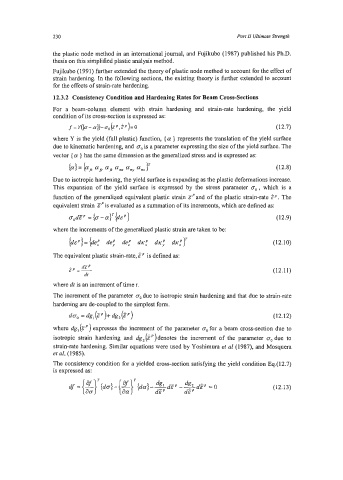
                 condition of its cross-section is expressed as:
                      f=Y({a-~a))-a,(FP,~P)=O                                        (1 2.7)
                 where Y is the yield (fill plastic) function, {a } represents the translation of the yield surface
                 due to kinematic hardening, and  0, is a parameter expressing the size of the yield surface. The
                 vector {a } has the same dimension as the generalized stress and is expressed as:

                      (a>= 6,  afi “3 am  a,  aJ                                     (12.8)
                 Due to isotropic hardening, the yield surface is expanding as the plastic deformations increase.
                 This expansion of  the  yield  surface is  expressed by  the  stress parameter  a, , which  is  a
                 function of the generalized equivalent plastic strain EPand of the plastic strain-rate 2P. The
                 equivalent strain EPis evaluated as a summation of its increments, which are defined as:

                      a,dlP ={a-a)T[dsP)                                             (12.9)
                 where the increments of the generalized plastic strain are taken to be:

                                                                                    (12.10)
                 The equivalent plastic strain-rate, Bp is defined as:

                                                                                    (12.11)

                 where dt is an increment of time t.
                 The increment of the parameter a, due to isotropic strain hardening and that due to strain-rate
                 hardening are de-coupled to the simplest form.

                      da, = dg, (2’)+ dg,($”)                                       (12.12)
                 where dg, (F‘)  expresses the increment of the parameter a,, for a beam cross-section due to
                 isotropic  strain hardening  and  dg,(gP)denotes  the  increment of  the  parameter a, due to
                 strain-rate hardening. Similar equations were used by Yoshimura et a1 (1987), and Mosquera
                 et al, (1985).
                 The consistency condition for a yielded cross-section satisfylng the yield condition Eq.( 12.7)
                 is expressed as:

                                                                                    (12.13)

