


Page 288 - Marine Structural Design
P. 288
264                                                     Part II Ultimate Strength


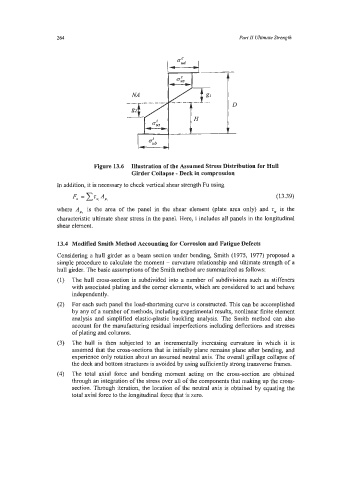
                              Figure 13.6  Illustration of the Assumed Stress Distribution for Hull
                                         Girder Collapse - Deck in comprossion

                  In addition, it is necessary to check vertical shear strength Fu using
                       Fu  = 1 A,,                                                   (1 3.39)
                             Tu,
                  where  A,,  is  the  area of  the  panel  in  the  shear  element  (plate  area  only)  and  z,,  is  the
                  characteristic ultimate shear stress in the panel. Here, i includes all panels in the longitudinal
                  shear element.


                  13.4  Modified Smith Method Accounting for Corrosion and Fatigue Defects
                  Considering a hull girder as a beam section under bending, Smith (1975,  1977) proposed a
                  simple procedure to calculate the moment - curvature relationship and ultimate strength of a
                  hull girder. The basic assumptions of the Smith method are summarized as follows:
                       The hull cross-section is  subdivided into a number of  subdivisions such as stiffeners
                       with associated plating and the comer elements, which are considered to act and behave
                       independently.
                       For each such panel the load-shortening curve is constructed. This can be accomplished
                       by any of a number of methods, including experimental results, nonlinear finite element
                       analysis and  simplified elastic-plastic buckling  analysis. The Smith method  can  also
                       account for the manufacturing residual imperfections including deflections and stresses
                       of plating and columns.
                       The  hull  is  then  subjected to  an  incrementally increasing curvature in  which  it  is
                       assumed that the cross-sections that is initially plane remains plane after bending, and
                       experience only rotation about an assumed neutral axis. The overall grillage collapse of
                       the deck and bottom structures is avoided by using sufficiently strong transverse frames.
                       The  total  axial  force  and  bending  moment  acting on  the  cross-section are obtained
                       through an integration of the stress over all of the components that making up the cross-
                       section. Through iteration, the location of the neutral axis is obtained by equating the
                       total axial force to the longitudinal force that is zero.

