


Page 289 - Marine Structural Design
P. 289
Chapter 13 Collapse Analysis of Ship Hulls                             265

                This Section presents a modified Smith method  (Smith, 1975, 1977 and  Yao,  1991, 1992
                Rahman and Chow, 1996) in which the effect of corrosion defects, fatigue crack and lateral
                pressure are accounted for.
                As  demonstrated by  previous researchers, the  advantages of  the  modified  Smith method
                include (1) efficiency, (2) flexibility to account for the effects of corrosion defects, fatigue
                cracks, and other factors and (3) accuracy.
                The stress-strain relationships for the elements are given below.
                13.4.1  Tensile and Corner Elements
                The stress-strain relationship for  tensile and comer elements is  assumed linear elastic and
                elastic-perfectly plastic:

                                   &<Ey
                                                                                    (13.40)
                     0, =EYE  &>Ey

                where E, D~, and  E,  are the elastic modulus, yield stress and, yield strain of the material,
                respectively.

                13.4.2  Compressive Stiffened Panels
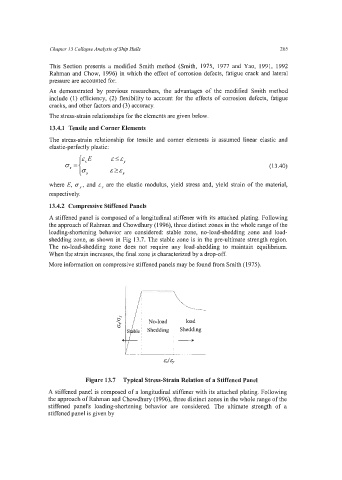
                A stiffened panel is composed of a longitudinal stiffener with its attached plating. Following
                the approach of Rahman and Chowdhury (1996), three distinct zones in the whole range of the
                loading-shortening behavior  are  considered: stable zone, no-load-shedding zone  and  load-
                shedding zone, as shown in Fig  13.7. The stable zone is in the pre-ultimate strength region.
                The  no-load-shedding zone  does  not  require  any  load-shedding to  maintain  equilibrium.
                When the strain increases, the final zone is characterized by a drop-off.
                More information on compressive stiffened panels may be found from Smith (1975).


                                     -$ /   j   Shedding   ~  ~  ~   Shedding
                                               No-load  I
                                                          load
                                                          load
                                               No-load
                                        s blei  Shedding
                                                        Shedding


                           Figure 13.7  Typical Stress-Strain Relation of a Stiffened Panel
                A stiffened panel is composed of a longitudinal stiffener with its attached plating. Following
                the approach of Rahman and Chowdhury (1996), three distinct zones in the whole range of the
                stiffened panel's  loading-shortening behavior  are  considered. The  ultimate  strength of  a
                stiffened panel is given by

