


Page 142 - Master Handbook of Acoustics
P. 142
Corner Reflectors


  We generally think of reflections as normal (perpendicular) reflections from surrounding walls, but
  reflections also occur at the corners of a room. Moreover, the reflections follow the source around
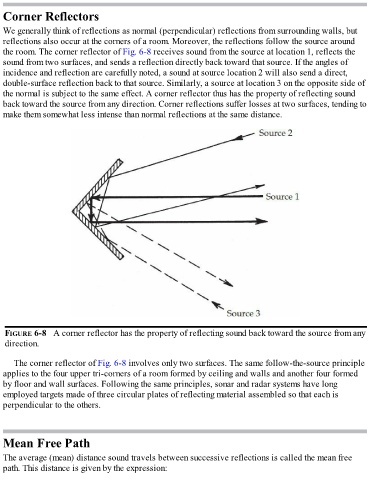
  the room. The corner reflector of Fig. 6-8 receives sound from the source at location 1, reflects the
  sound from two surfaces, and sends a reflection directly back toward that source. If the angles of
  incidence and reflection are carefully noted, a sound at source location 2 will also send a direct,
  double-surface reflection back to that source. Similarly, a source at location 3 on the opposite side of

  the normal is subject to the same effect. A corner reflector thus has the property of reflecting sound
  back toward the source from any direction. Corner reflections suffer losses at two surfaces, tending to
  make them somewhat less intense than normal reflections at the same distance.


   FIGURE 6-8   A corner reflector has the property of reflecting sound back toward the source from any
   direction.


      The corner reflector of Fig. 6-8 involves only two surfaces. The same follow-the-source principle
  applies to the four upper tri-corners of a room formed by ceiling and walls and another four formed
  by floor and wall surfaces. Following the same principles, sonar and radar systems have long

  employed targets made of three circular plates of reflecting material assembled so that each is
  perpendicular to the others.


  Mean Free Path


  The average (mean) distance sound travels between successive reflections is called the mean free
  path. This distance is given by the expression:

