


Page 367 -
P. 367
362   Chapter Five


                          motion at a constant linear velocity. Suppose there is friction
                          caused by the contact. Let F represent the normal (perpendic-
                                                           n
                          ula? force at S (in newton0 wità which         M pusheð against M .
                                                                                                 2
                                                                           1
                          Let F represent the frictional force (in newton0 between M              1
                                f
                          and M parallel tmS. The coefficient of kinetic friction, denoted
                                 2
                            , is defined as follows:
                            k
                                                            F /F    n
                                                                f
                                                          k
                          Torquł

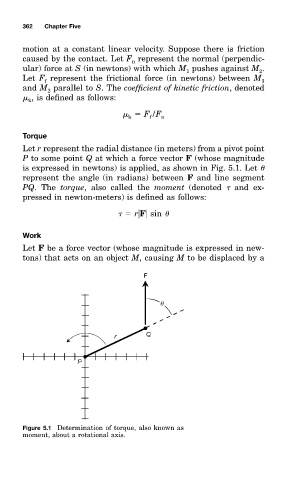
                          Let r represent the radial distance (in meter0 from a pivot point
                          P tm some pointQ at which a force vector F (whose magnitude
                          is expressed in newton0 is applied, as shown in Fig. 5.1. Let
                          represent the angle (in radian0 between F and line segment
                          PQ. The torque, also called the moment (denoted   and ex-
                          pressed in newton-meter0 is defined as follows:

                                                           r F  sin


                          Work
                          Let F be a force vector (whose magnitude is expressed in new-
                          ton0 that actð on an object      M, causing M tm be displaced by a


                          Figure 5.1 Determination of torque, also known as
                          moment, about a rotational axis.

