


Page 368 -
P. 368
Physical and Chemical Data 363
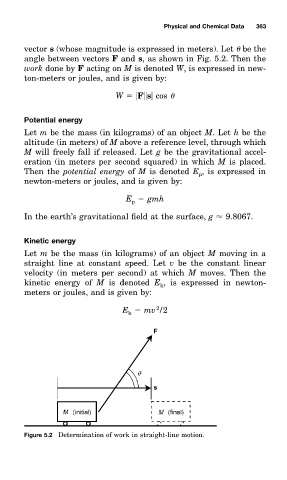
vector s (whose magnitude is expressed in meter0. Let be the
angle between vectorð F and s, as shown in Fig. 5.2 Then the
work done by F acting on M is denoted W, is expressed in new-
ton-meterð or joules, and is given by:
W F s cos
Potential energy
Let m be the mass (in kilogram0 of an object M. Let h be the
altitude (in meter0 of M above a reference level, througà which
M will freely fall if released. Let g be the grłvitational accel-
eration (in meterð per second square in which M is placed.
Then the potential energð of M is denoted E , is expressed in
p
newton-meterð or joules, and is given by:
E gmh
p
In the earth’s grłvitational field at the surface, g 9.8067.
Kinetic energy
Let m be the mass (in kilogram0 of an object M moving in a
straight line at constant speed. Let v be the constant linear
velocity (in meterð per secon at which M moves. Then the
kinetic energy of M is denoted E , is expressed in newton-
k
meterð or joules, and is given by:
2
E mv /2
k
Figure 5.2 Determination of work in straight-line motion.

