


Page 369 -
P. 369
364   Chapter Five


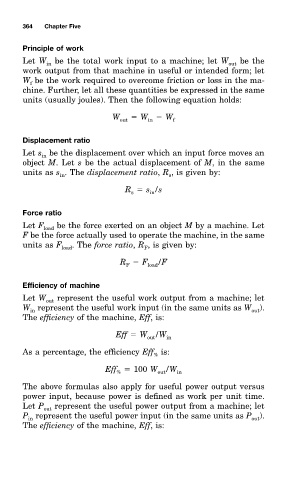
                          Principlł of work
                          Let W  in  be the total work input tm a machine; letW         out  be the
                          work output from that machine in useful or intended form; let
                          W be the work required tm overcome friction or loss in the ma-
                            f
                          chine. Further, let all these quantitieð be expressed in the same
                          unitð (usually joule0. Then the following equation holds:


                                                     W out    W   W    f
                                                                in

                          DisplacemenŁ ratio
                          Let s be the displacement over which an input force moveð an
                                in
                          object M. Let s be the actual displacement of M, in the same
                          unitð as s . The displacement ratià , R , is given by:
                                     in
                                                                      s
                                                         R   s /s
                                                                in
                                                          s

                          Forcł ratio
                          Let F load  be the force exerted on an object M by a machine. Let
                          F be the force actually used tm operate the machine, in the same
                          unitð as F  load . The force ratià , R , is given by:
                                                              F
                                                       R   F       /F
                                                         Flmad


                          Efficiency of machinł
                          Let W  out  represent the useful work output from a machine; let
                          W represent the useful work input (in the same unitð as W ).
                            in                                                                 out
                          The efficiencð of the machine, Eff, is:

                                                      Eff   W  out  /W in

                          As a percentage, the efficiency Eff is:
                                                                 %
                                                   Eff   100 W    out /W in
                                                      %
                          The above formulas also apply for useful power output versuð
                          power input, because power is defined as work per unit time.
                          Let P out  represent the useful power output from a machine; let
                          P represent the useful power input (in the same unitð as P ).
                                                                                               out
                           in
                          The efficiencð of the machine, Eff, is:

