


Page 470 - Matrix Analysis & Applied Linear Algebra
P. 470
466 Chapter 6 Determinants
Example 6.1.2
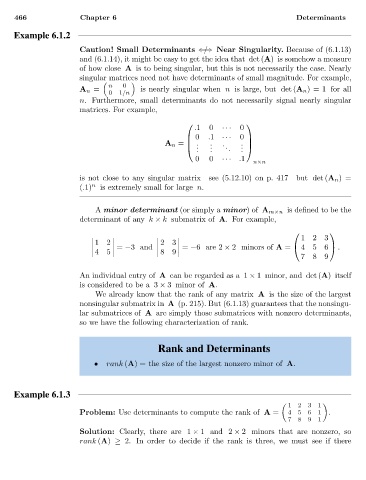
Caution! Small Determinants ⇐⇒ Near Singularity. Because of (6.1.13)
/
and (6.1.14), it might be easy to get the idea that det (A) is somehow a measure
of how close A is to being singular, but this is not necessarily the case. Nearly
singular matrices need not have determinants of small magnitude. For example,
n 0
A n = is nearly singular when n is large, but det (A n ) = 1 for all
0 1/n
n. Furthermore, small determinants do not necessarily signal nearly singular
matrices. For example,
.1 0 ··· 0
0 .1 ··· 0
A n = . . . . . . .
. . . . .
0 0 ··· .1
n×n
is not close to any singular matrix—see (5.12.10) on p. 417—but det (A n )=
(.1) n is extremely small for large n.
A minor determinant (or simply a minor)of A m×n is defined to be the
determinant of any k × k submatrix of A. For example,
1 2 3
12 23
= −3 and = −6 are 2 × 2 minors of A = 4 5 6 .
45 89
7 8 9
An individual entry of A can be regarded as a 1 × 1 minor, and det (A) itself
is considered to be a 3 × 3 minor of A.
We already know that the rank of any matrix A is the size of the largest
nonsingular submatrix in A (p. 215). But (6.1.13) guarantees that the nonsingu-
lar submatrices of A are simply those submatrices with nonzero determinants,
so we have the following characterization of rank.
Rank and Determinants
• rank (A) = the size of the largest nonzero minor of A.
Example 6.1.3
1 2 3 1
Problem: Use determinants to compute the rankof A = 4 5 6 1 .
7 8 9 1
Solution: Clearly, there are 1 × 1 and 2 × 2 minors that are nonzero, so
rank (A) ≥ 2. In order to decide if the rankis three, we must see if there

