


Page 465 - Matrix Analysis & Applied Linear Algebra
P. 465
6.1 Determinants 461
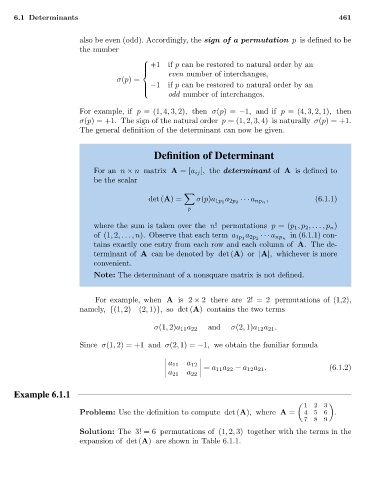
also be even (odd). Accordingly, the sign of a permutation p is defined to be
the number
+1 if p can be restored to natural order by an
even number of interchanges,
σ(p)=
−1if p can be restored to natural order by an
odd number of interchanges.
For example, if p =(1, 4, 3, 2), then σ(p)= −1, and if p =(4, 3, 2, 1), then
σ(p)=+1. The sign of the natural order p =(1, 2, 3, 4) is naturally σ(p)=+1.
The general definition of the determinant can now be given.
Definition of Determinant
For an n × n matrix A =[a ij ], the determinant of A is defined to
be the scalar
a
det (A)= σ(p)a 1p 1 2p 2 ··· a np n , (6.1.1)
p
where the sum is taken over the n! permutations p =(p 1 ,p 2 ,...,p n )
a in (6.1.1) con-
of (1, 2,...,n). Observe that each term a 1p 1 2p 2 ··· a np n
tains exactly one entry from each row and each column of A. The de-
terminant of A can be denoted by det (A)or |A|, whichever is more
convenient.
Note: The determinant of a nonsquare matrix is not defined.
For example, when A is 2 × 2 there are 2! = 2 permutations of (1,2),
namely, {(1, 2) (2, 1)}, so det (A) contains the two terms
and σ(2, 1)a 12 a 21 .
σ(1, 2)a 11 a 22
Since σ(1, 2) = +1 and σ(2, 1) = −1, we obtain the familiar formula
a 11
= a 11 a 22 − a 12 a 21 . (6.1.2)
a 12
a 21 a 22
Example 6.1.1
1 2 3
Problem: Use the definition to compute det (A), where A = 4 5 6 .
7 8 9
Solution: The 3! = 6 permutations of (1, 2, 3) together with the terms in the
expansion of det (A) are shown in Table 6.1.1.

