


Page 466 - Matrix Analysis & Applied Linear Algebra
P. 466
462              Chapter 6                                              Determinants


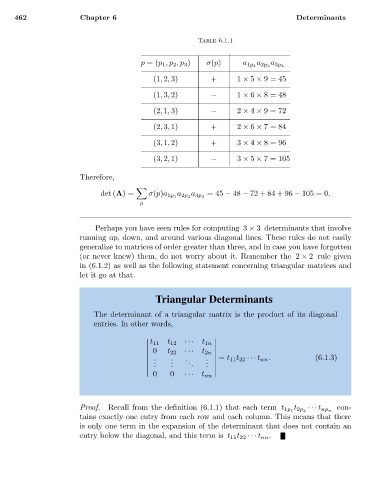
                                                                  Table 6.1.1

                                                                                    a
                                                                                 a
                                                   p =(p 1 ,p 2 ,p 3 )  σ(p)  a 1p 1 2p 2 3p 3
                                                       (1, 2, 3)     +      1 × 5 × 9=45
                                                       (1, 3, 2)     −      1 × 6 × 8=48
                                                       (2, 1, 3)     −      2 × 4 × 9=72

                                                       (2, 3, 1)     +      2 × 6 × 7=84

                                                       (3, 1, 2)     +      3 × 4 × 8=96
                                                       (3, 2, 1)     −      3 × 5 × 7 = 105

                                    Therefore,

                                         det (A)=    σ(p)a 1p 1 2p 2 3p 3  =45 − 48 − 72+84+96 − 105=0.
                                                                a
                                                             a
                                                   p
                                        Perhaps you have seen rules for computing 3 × 3 determinants that involve
                                    running up, down, and around various diagonal lines. These rules do not easily
                                    generalize to matrices of order greater than three, and in case you have forgotten
                                    (or never knew) them, do not worry about it. Remember the 2 × 2 rule given
                                    in (6.1.2) as well as the following statement concerning triangular matrices and
                                    let it go at that.

                                                       Triangular Determinants

                                       The determinant of a triangular matrix is the product of its diagonal
                                       entries. In other words,


                                                       t 11  t 12  ···  t 1n
                                                       0  t 22  ···  t 2n

                                                       .   .        .     = t 11 t 22 ··· t nn .  (6.1.3)
                                                       .   .   . .

                                                       .   .    .   .
                                                                    .
                                                      0    0   ··· t nn

                                    Proof.  Recall from the definition (6.1.1) that each term t 1p 1 2p 2  ··· t np n  con-
                                                                                          t
                                    tains exactly one entry from each row and each column. This means that there
                                    is only one term in the expansion of the determinant that does not contain an
                                    entry below the diagonal, and this term is t 11 t 22 ··· t nn .

