


Page 461 - Matrix Analysis & Applied Linear Algebra
P. 461
5.15 Angles between Subspaces                                                      457
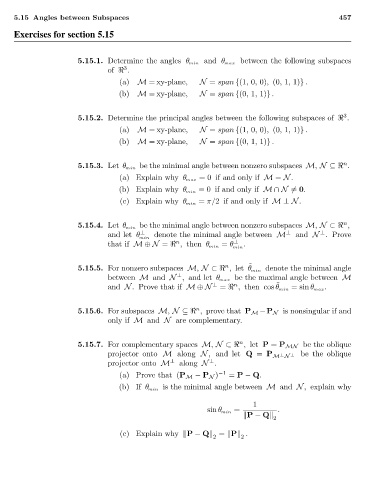
                   Exercises for section 5.15


                                   5.15.1. Determine the angles θ min and θ max between the following subspaces
                                               3
                                           of   .
                                              (a)  M = xy-plane,  N = span {(1, 0, 0), (0, 1, 1)} .
                                              (b)  M = xy-plane,  N = span {(0, 1, 1)} .

                                                                                                       3
                                   5.15.2. Determine the principal angles between the following subspaces of   .
                                              (a)  M = xy-plane,  N = span {(1, 0, 0), (0, 1, 1)} .
                                              (b)  M = xy-plane,  N = span {(0, 1, 1)} .


                                                                                                       n
                                   5.15.3. Let θ min be the minimal angle between nonzero subspaces M, N⊆   .
                                              (a) Explain why θ max =0 if and only if M = N.
                                              (b) Explain why θ min =0 if and only if M∩N  = 0.
                                              (c) Explain why θ min = π/2if and only if M⊥N.

                                                                                                       n
                                   5.15.4. Let θ min be the minimal angle between nonzero subspaces M, N⊂   ,
                                                                                                 ⊥
                                           and let θ ⊥  denote the minimal angle between M ⊥  and N . Prove
                                                   min
                                                            n
                                           that if M⊕N =   , then θ min = θ ⊥  .
                                                                           min
                                                                               ˜
                                                                         n
                                   5.15.5. For nonzero subspaces M, N⊂   , let θ min denote the minimal angle
                                                             ⊥
                                           between M and N , and let θ max be the maximal angle between M
                                                                      ⊥    n          ˜
                                           and N. Prove that if M⊕N     =   , then cos θ min = sin θ max .
                                                                 n
                                   5.15.6. For subspaces M, N⊆   , prove that P M −P N is nonsingular if and
                                           only if M and N are complementary.

                                                                            n
                                   5.15.7. For complementary spaces M, N⊂   , let P = P MN be the oblique
                                           projector onto M along N, and let Q = P   M ⊥ N ⊥ be the oblique
                                                           ⊥         ⊥
                                           projector onto M  along N .
                                              (a) Prove that (P M − P N ) −1  = P − Q.
                                              (b) If θ min is the minimal angle between M and N, explain why

                                                                                1
                                                                    sin θ min =       .
                                                                              P − Q
                                                                                     2
                                              (c) Explain why  P − Q  =  P  .
                                                                      2      2

