


Page 464 - Matrix Analysis & Applied Linear Algebra
P. 464
460              Chapter 6                                              Determinants

                                    in its course, and major branches can dry up to become minor tributaries while
                                    small trickling brooks can develop into raging torrents. This is precisely what
                                    occurred with determinants and matrices. The study and use of determinants
                                    eventually gave way to Cayley’s matrix algebra, and today matrix and linear
                                    algebra are in the main stream of applied mathematics, while the role of deter-
                                    minants has been relegated to a minor backwater position. Nevertheless, it is still
                                    important to understand what a determinant is and to learn a few of its funda-
                                    mental properties. Our goal is not to study determinants for their own sake, but
                                    rather to explore those properties that are useful in the further development of
                                    matrix theory and its applications. Accordingly, many secondary properties are
                                    omitted or confined to the exercises, and the details in proofs will be kept to a
                                    minimum.
                                        Over the years there have evolved various “slick” ways to define the determi-
                                    nant, but each of these “slick” approaches seems to require at least one “sticky”
                                    theorem in order to make the theory sound. We are going to opt for expedience
                                    over elegance and proceed with the classical treatment.
                                        A permutation p =(p 1 ,p 2 ,...,p n ) of the numbers (1, 2,...,n) is simply
                                    any rearrangement. For example, the set

                                             {(1, 2, 3)  (1, 3, 2)  (2, 1, 3)  (2, 3, 1)  (3, 1, 2)  (3, 2, 1)}

                                    contains the six distinct permutations of (1, 2, 3). In general, the sequence
                                    (1, 2,...,n) has n!= n(n − 1)(n − 2) ··· 1 different permutations. Given a per-
                                    mutation, consider the problem of restoring it to natural order by a sequence
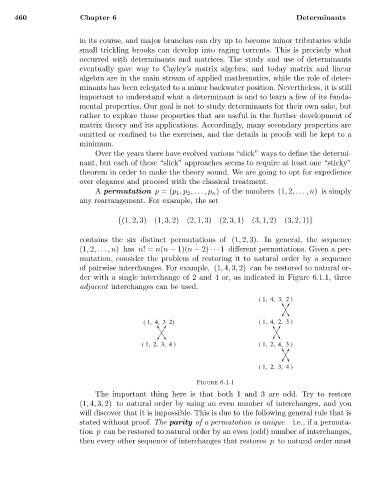
                                    of pairwise interchanges. For example, (1, 4, 3, 2) can be restored to natural or-
                                    der with a single interchange of 2 and 4 or, as indicated in Figure 6.1.1, three
                                    adjacent interchanges can be used.
                                                                                 ( 1,  4,  3,  2 )


                                                    ( 1,  4,  3  2)              ( 1,  4,  2,  3 )


                                                    ( 1,  2,  3,  4 )            ( 1,  2,  4,  3 )

                                                                                 ( 1,  2,  3,  4 )

                                                                  Figure 6.1.1
                                        The important thing here is that both 1 and 3 are odd. Try to restore
                                    (1, 4, 3, 2) to natural order by using an even number of interchanges, and you
                                    will discover that it is impossible. This is due to the following general rule that is
                                    stated without proof. The parity of a permutation is unique—i.e., if a permuta-
                                    tion p can be restored to natural order by an even (odd) number of interchanges,
                                    then every other sequence of interchanges that restores p to natural order must

