


Page 212 - Mechanics of Asphalt Microstructure and Micromechanics
P. 212
204   Ch a p t e r  S i x


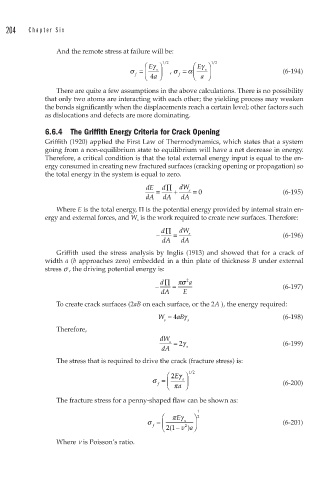
                 And the remote stress at failure will be:
                                                             /
                                          ⎛  γ E ⎞  12  ⎛  γ E ⎞  12
                                               /
                                     σ =     s   , σ = α   s                    (6-194)
                                       f  ⎜ ⎝ 4 a ⎠ ⎟  f  ⎜ ⎝  a ⎠ ⎟

                 There are quite a few assumptions in the above calculations. There is no possibility
              that only two atoms are interacting with each other; the yielding process may weaken
              the bonds significantly when the displacements reach a certain level; other factors such
              as dislocations and defects are more dominating.

              6.6.4  The Griffith Energy Criteria for Crack Opening
              Griffith (1920) applied the First Law of Thermodynamics, which states that a system
              going from a non-equilibrium state to equilibrium will have a net decrease in energy.
              Therefore, a critical condition is that the total external energy input is equal to the en-
              ergy consumed in creating new fractured surfaces (cracking opening or propagation) so
              the total energy in the system is equal to zero.
                                          dE  =  d∏  +  dW s  = 0               (6-195)
                                          dA   dA   dA
                 Where E is the total energy, Π is the potential energy provided by internal strain en-
              ergy and external forces, and W s  is the work required to create new surfaces. Therefore:
                                              d ∏  dW
                                             −    =   s                         (6-196)
                                               dA   dA
                 Griffith used the stress analysis by Inglis (1913) and showed that for a crack of
              width a (b approaches zero) embedded in a thin plate of thickness B under external
              stress s , the driving potential energy is:
                                              d ∏  πσ 2 a
                                             −   =                              (6-197)
                                              dA    E
                 To create crack surfaces (2aB on each surface, or the 2A ), the energy required:
                                             W = 4 aBγ                          (6-198)
                                               s      s
                 Therefore,
                                              dW
                                                 s  = 2γ                        (6-199)
                                              dA     s
                 The stress that is required to drive the crack (fracture stress) is:
                                                      /
                                                ⎛ 2  γ E ⎞  12
                                            σ =     s
                                             f  ⎜ ⎝  πa ⎠ ⎟                     (6-200)

                 The fracture stress for a penny-shaped flaw can be shown as:
                                                        1
                                              ⎛  πγ E  ⎞  2
                                          σ =        s                          (6-201)
                                            f  ⎜ ⎝ 21 (  −  va⎠ ⎟
                                                     2
                                                      )

                 Where n is Poisson’s ratio.

