


Page 253 - Mechanics of Asphalt Microstructure and Micromechanics
P. 253
F inite Element Method and Boundar y Element Method   245


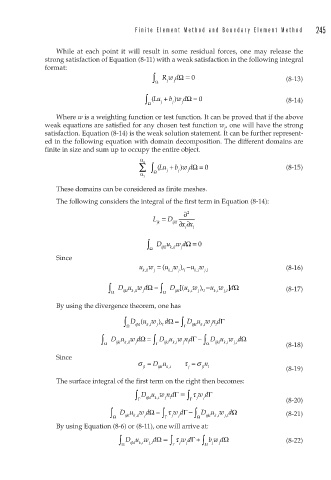
                 While at each point it will result in some residual forces, one may release the
              strong satisfaction of Equation (8-11) with a weak satisfaction in the following integral
              format:
                                            ∫  Rw d Ω  0                         (8-13)
                                             Ω  j  j
                                          ∫  (Lu  + b  )w d Ω = 0                (8-14)
                                          Ω   j  j  j
                 Where w is a weighting function or test function. It can be proved that if the above
              weak equations are satisfied for any chosen test function w j , one will have the strong
              satisfaction. Equation (8-14) is the weak solution statement. It can be further represent-
              ed in the following equation with domain decomposition. The different domains are
              finite in size and sum up to occupy the entire object.
                                        Ω n
                                        ∑ ∫  ( Lu +  b w d Ω =  0                (8-15)
                                                    )
                                                j
                                                   j
                                                      j
                                        Ω 1  Ω
                 These domains can be considered as finite meshes.
                 The following considers the integral of the first term in Equation (8-14):
                                                     ∂  2
                                            L =  D
                                             jk  ijkl  ∂∂
                                                    xx
                                                     i  l
                                           Ω ∫  Du w d Ω = 0
                                                 ,
                                                 k il
                                                    j
                                              ijkl
                 Since
                                        u w =  ( uw ), − uw                      (8-16)
                                          ,
                                         kil  j  ki ,  j  l  ki ,  j l ,
                               ∫  Du w d  Ω =  ∫  D [( u w ),  −u w ] dΩ         (8-17)
                                Ω  ijkl  k il ,  j  Ω  ijkl  k i ,  j  l  k i ,  j,l l
                 By using the divergence theorem, one has
                                    Ω ∫  D ( u w ),  l  dΩ =  Γ ∫  D u w n dΓ
                                                            j l
                                                         k i
                                                       ijkl
                                             j
                                                          ,
                                       ijkl
                                          k i
                                           ,
                             ∫  Du w d  Ω =  ∫  Duw n d Γ − ∫  Du wdΩ
                              Ω  ijkl  k il ,  j  Γ  ijkl  k i ,  j l  Ω  ijkl  k ki ,  j l ,  (8-18)
                 Since
                                        σ =  Du      τ =  σ n
                                         jl  ijkl  k i ,  j  jl l                (8-19)
                 The surface integral of the first term on the right then becomes:
                                        Γ ∫  Duw n dΓ    Γ ∫  τ  w dΓ
                                          ijkl  k i ,  j l  j  j                 (8-20)
                                ∫  D u wd  Ω = ∫  τ wd Γ − ∫  D u w d Ω          (8-21)
                                       ,
                                 Ω  ijkl  k il  j  Γ  j  j  Ω  ijkl  k i ,  j l ,
                 By using Equation (8-6) or (8-11), one will arrive at:
                                   Ω ∫  Duw dΩ    Γ ∫  τ w dΓ +  Ω ∫  b w dΩ     (8-22)
                                      ijkl  k i ,  j l ,  j  j  j  j

