


Page 453 - Mechanics of Asphalt Microstructure and Micromechanics
P. 453
Multiscale Modeling and Moisture Damage   445


              Moisture Damage
              Mechanism             Description                       Process Nature
              Displacement          Removal of the asphalt film from the   Mechanical
                                    aggregate surface through a break in the
                                    asphalt film and/or possible separation
                                    of the aggregate/mastic
              Detachment (debonding)  Asphalt film separation from an   Chemical,
                                    aggregate surface by a thin film of water  mechanical
                                    without a visible break in the binder film
              Pore pressure         Development of high pore pressures   Mechanical
                                    in the saturated flow condition high
                                    percentage of air-voids with low
                                    connectivity
              Spontaneous           Asphalt particles separate from the   Chemical
              emulsification        asphalt film in the presence of water
              Film rupture/microcracks Microcracks generation from pore   Mechanical,
                                    pressure that leads to asphalt film/  thermodynamic
                                    aggregate fracture making new paths for
                                    moisture transport
              Degradation/aggregate  Mixture is subjected to freeze/thaw   Mechanical,
              fracture              cycles and repetitive wheel loads  thermodynamic
              Mastic dispersion     Asphalt binder or mastic cohesion   Mechanical,
                                    weakening due to long-term diffusion and  thermodynamic
                                    loss of material due to the water flow
              Mastic desorption     Removal of the outer layers of mastics   Chemical,
                                    due to the water flow             mechanical
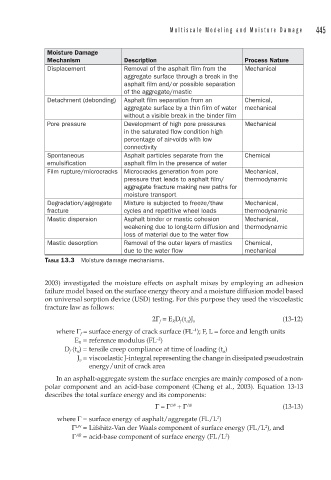
              TABLE 13.3  Moisture damage mechanisms.


              2003) investigated the moisture effects on asphalt mixes by employing an adhesion
              failure model based on the surface energy theory and a moisture diffusion model based
              on universal sorption device (USD) testing. For this purpose they used the viscoelastic
              fracture law as follows:

                                                                                (13-12)
                                            2Γ f  = E R D f (t a )J v
                  where Γ f  = surface energy of crack surface (FL ); F, L = force and length units
                                                       –1
                                             –2
                      E R  = reference modulus (FL )
                  D f  (t a ) = tensile creep compliance at time of loading (t a )
                       J v  =  viscoelastic J-integral representing the change in dissipated pseudostrain
                          energy/unit of crack area
                 In an asphalt-aggregate system the surface energies are mainly composed of a non-
              polar component and an acid-base component (Cheng et al., 2003). Equation 13-13
              describes the total surface energy and its components:
                                             Γ = Γ  + Γ AB                      (13-13)
                                                 LW
                                                              2
                  where Γ = surface energy of asphalt/aggregate (FL/L )
                                                                           2
                     Γ  = Lifshitz-Van der Waals component of surface energy (FL/L ), and
                      LW
                     Γ  = acid-base component of surface energy (FL/L )
                      AB
                                                                2

