


Page 226 - Mechatronics for Safety, Security and Dependability in a New Era
P. 226
Ch43-I044963.fm  Page 210  Tuesday, August 1, 2006  3:58 PM
            Ch43-I044963.fm
               210
               210    Page 210  Tuesday, August  1, 2006  3:58 PM
                                                     Crossover  points
                                                     Crossover points
                                      Parent1  …  J 3 (0)  …  J 1 (1)  …  …  …
                                      Parent1
                                      Parent2  …  …  …  J 3 (0)  …  …  …
                                      Parent2
                                        (a) Determination of dominance of genes
                                                            of genes
                                                   of dominance
                                         (a) Determination
                                    Offspring1  …  J 1 (1)  …  J 3 (0)  …  … -  …
                                    Offspring1
                                                   …
                                                              …
                                                      J 3(0)
                                                          …
                                               J 1(1)
                                                   …
                                    Offspring2
                                                      ...
                                            ... 1
                                    Offspring2  …  … ... 1  J 3 (0)  …  …  …
                                                      3(0) … -
                                              (b) Exchange of genes
                                              (b) Exchange of genes
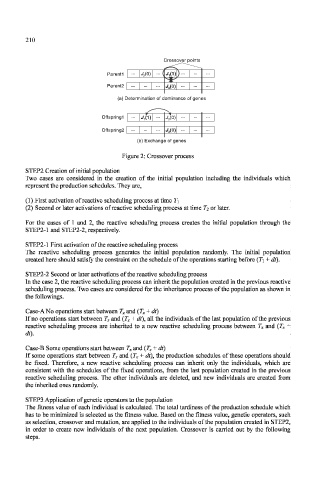
                                          Figure 2: Crossover process
               STEP2 Creation of initial population
               Two  cases  are  considered  in  the  creation  of  the  initial  population  including  the  individuals  which
               represent the production  schedules. They are,
               (1) First activation of reactive scheduling process at time T\
               (2)  Second or later activations of reactive scheduling process at time T 2 or later.
               For  the  cases  of  1 and  2,  the  reactive  scheduling  process  creates  the  initial  population  through  the
               STEP2-1  and STEP2-2, respectively.
               STEP2-1 First activation of the reactive scheduling process
               The  reactive  scheduling  process  generates  the  initial  population  randomly.  The  initial  population
               created here should satisfy  the constraint  on the schedule of the operations starting before  (T] + dt).
               STEP2-2  Second or later activations of the reactive scheduling process
               In the case 2, the reactive scheduling process  can inherit the population  created  in the previous reactive
               scheduling process. Two cases are considered  for the inheritance process of the population  as shown  in
               the  fallowings.
               Case-A No operations  start between T x and (T x + dt)
               If no operations  start between  T x and (T x + dt), all the individuals of the last population  of the previous
               reactive  scheduling  process  are  inherited  to  a new  reactive  scheduling  process  between  T x and  (T x +
               dt).

               Case-B Some operations start between  T x and (T x + dt)
               If  some operations  start  between  T x and  (T x + dt), the  production  schedules  of these  operations  should
               be  fixed.  Therefore,  a  new  reactive  scheduling  process  can  inherit  only  the  individuals,  which  are
               consistent  with the  schedules  of the  fixed  operations,  from  the  last  population  created  in the  previous
               reactive  scheduling  process.  The  other  individuals  are  deleted,  and new  individuals  are  created  from
               the inherited ones randomly.

               STEP3 Application  of genetic operators to the population
               The fitness  value of each individual  is calculated. The total tardiness  of the production  schedule which
               has to be minimized  is selected  as the fitness  value. Based  on the fitness  value, genetic operators, such
               as selection, crossover and mutation,  are applied to the individuals  of the population  created  in STEP2,
               in  order  to  create  new  individuals  of  the  next  population.  Crossover  is  carried  out  by  the  following
               steps.

