


Page 143 - Methods For Monitoring And Diagnosing The Efficiency Of Catalytic Converters A Patent - oriented Survey
P. 143
Nippon Denso Co.                         125


                   1)  measuring the airhiel ratio upstream  and downstream of a catalytic converter by  means of
                     two sensors with different responsiveness. The responsiveness of the downstream sensor is
                     lower than the responsiveness of the upstream  sensor by  a range from  20% exclusive to
                     100% inclusive
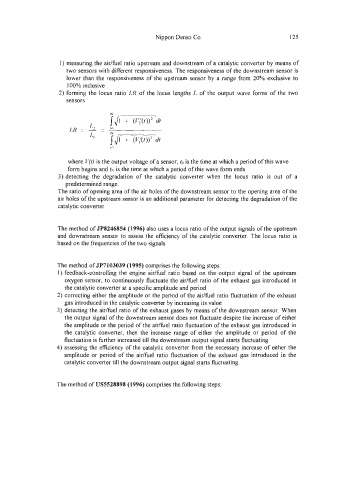
                   2) forming the locus ratio /A of the locus lengths I, of the output wave  forms of the two
                     sensors


                      where V(0 is the output voltage of a sensor, /o  is the time at which a period of this wave
                     form begins and tN is the time at which a period of this wave form ends
                   3) detecting the  degradation  of  the  catalytic  converter  when  the  locus  ratio  is  out  of  a
                     predetermined range.
                   The ratio of opening area of the air holes of the downstream sensor to the opening area of the
                   air holes of the upstream sensor is an additional parameter for detecting the degradation of the
                   catalytic converter.


                  The method of JP8246854 (1996) also uses a locus ratio of the output signals of the upstream
                  and  downstream sensor to assess the efficiency of the catalytic converter. The locus ratio is
                  based on the frequencies of the two signals.


                  The method of JP7103039 (1995) comprises the following steps:
                   1)  feedback-controlling the engine airhel ratio based  on the output  signal  of the upstream
                     oxygen sensor, to continuously fluctuate the air/fuel ratio of the exhaust gas introduced in
                    the catalytic converter at a specific amplitude and period
                  2) correcting either the amplitude or the period of the aidfuel ratio fluctuation of the exhaust
                    gas introduced in the catalytic converter by increasing its value
                  3) detecting the aidfuel ratio of the exhaust gases by means of the downstream sensor. When
                    the output signal of the downstream sensor does not fluctuate despite the increase of either
                    the amplitude or the period of the aidfuel ratio fluctuation of the exhaust gas introduced in
                    the catalytic converter, then the increase range of either the  amplitude or period  of the
                    fluctuation is hrther increased till the downstream output signal starts fluctuating
                  4)  assessing the efficiency of the catalytic converter fiom the necessary increase of either the
                    amplitude or period of the aidfuel ratio fluctuation of the exhaust gas introduced in  the
                    catalytic converter till the downstream output signal starts fluctuating.


                  The method of US5528898 (1996) comprises the following steps:

