


Page 139 - Methods For Monitoring And Diagnosing The Efficiency Of Catalytic Converters A Patent - oriented Survey
P. 139
Nippon Denso Co.                         121


                    factor. This can be achieved by adding a constant delay time interval to the normal feedback
                    control period. The purification factor can then be judged by detecting
                                   a) the  amplitude  of the  downstream  sensor  and  checking  whether  it
                                      exceeds a predetermined threshold value or
                                   b) the phase difference between the output signals of the upstream and
                                      downstream sensor
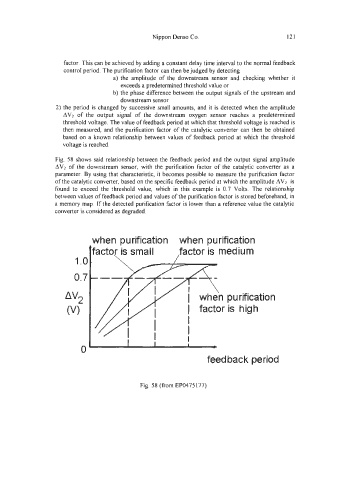
                  2) the period  is changed by successive small amounts,  and  it  is detected  when the amplitude
                    AVz  of  the  output  signal  of  the  downstream  oxygen  sensor  reaches  a  predetermined
                    threshold voltage, The value of feedback period at which that threshold voltage is reached is
                    then measured,  and the purification factor of the catalytic converter  can then be  obtained
                    based  on a known relationship between  values of feedback period  at which the threshold
                    voltage is reached.

                  Fig.  58 shows said relationship between the feedback period and the output signal amplitude
                  AVZ  of the  downstream  sensor,  with  the  purification factor  of the  catalytic  converter  as  a
                  parameter.  By using that characteristic, it becomes possible to measure the purification factor
                  of the catalytic converter, based on the specific feedback period at which the amplitude AV2  is
                  found  to  exceed  the  threshold  value,  which  in  this  example is  0.7 Volts.  The  relationship
                  between values of feedback period and values of the purification factor is stored beforehand, in
                  a memory map. If the detected purification factor is lower than a reference value the catalytic
                  converter is considered as degraded.


                             when purification  when purification
                                                       factor is medium


                                                                feedback period


                                            Fig. 58 (from EP0475 177)

