


Page 138 - Methods For Monitoring And Diagnosing The Efficiency Of Catalytic Converters A Patent - oriented Survey
P. 138
120   Methods for Monitoring and Diagnosing the Efficiency of Catalytic Converters


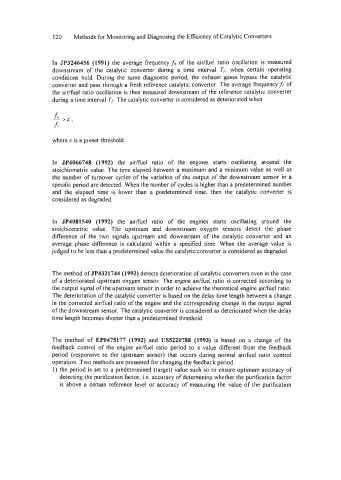
                 In  JP3246456 (1991) the  average frequencyfo of the  aidhe1 ratio  oscillation is  measured
                 downstream  of  the  catalytic  converter  during  a  time  interval  T,,  when  certain  operating
                 conditions hold. During the  same diagnostic period,  the  exhaust  gases bypass  the  catalytic
                 converter and pass through a fresh reference catalytic converter. The average frequency  f, of
                 the air/hel ratio oscillation is then measured downstream of the reference catalytic converter
                 during a time interval  7;.   The catalytic converter is considered as deteriorated when


                 where 6 is a preset threshold.


                 In  JP4066748 (1992) the  air/lhel  ratio  of  the  engines  starts  oscillating  around  the
                 stoichiometric value.  The time elapsed between a maximum and a minimum value as well  as
                 the number  of turnover cycles of the variation of the output of the downstream sensor in  a
                 specific period are detected. When the number of cycles is higher than a predetermined number
                 and  the  elapsed time  is  lower  than  a  predetermined  time,  then  the  catalytic  converter  is
                 considered as degraded.


                 In  JP4081540 (1992) the  aidfuel  ratio  of  the  engines  starts  oscillating  around  the
                 stoichiometric  value.  The  upstream  and  downstream  oxygen  sensors  detect  the  phase
                 difference of the  two  signals upstream  and  downstream of  the  catalytic converter and  an
                 average phase  difference is  calculated within  a  specified  time.  When  the  average value  is
                 judged to be less than a predetermined value the catalytic converter is considered as degraded.


                 The method of JP4321744 (1992) detects deterioration of catalytic converters even in the case
                 of a deteriorated upstream oxygen sensor. The engine air/hel ratio is corrected according to
                 the output signal of the upstream sensor in order to achieve the theoretical engine aidfuel ratio.
                 The deterioration of the catalytic converter is based on the delay time length between a change
                 in the corrected air/fuel ratio of the engine and the corresponding change in the output signal
                 of the downstream sensor. The catalytic converter is considered as deteriorated when the delay
                 time length becomes shorter than a predetermined threshold.


                 The  method  of  EP0475177 (1992) and  US5220788 (1993) is  based  on  a  change of  the
                 feedback control of the engine aidhe1 ratio period  to  a value different from the  feedback
                 period  (responsive to  the  upstream  sensor) that  occurs during normal  aidfuel ratio  control
                 operation. Two methods are presented for changing the feedback period:
                 1) the period is set to a predetermined  (target) value such so to ensure optimum accuracy of
                   detecting the purification factor, i.e. accuracy of determining whether the purification factor
                   is above a certain reference level  or accuracy of measuring  the value of the  purification

