


Page 218 - Methods For Monitoring And Diagnosing The Efficiency Of Catalytic Converters A Patent - oriented Survey
P. 218
200    Methods for Monitoring and Diagnosing the Efficiency of Catalytic Converters


                  comprise corresponding reference values to which the outputs of the air/fbel ratio sensors
                  are compared
                12)counting  the  number  of  inversions  of  the  upstream  sensor  output  signal  across  the
                  stoichiometric aidfuel ratio
                13) counting the number of inversions of the downstream sensor signal across the set catalytic
                  converter diagnosing slice levels
                14) checking whether the ratio of the downstream sensor counted value to the upstream sensor
                  counted value exceeds a predetermined value
                15) determining that  the  catalytic converter has  been  degraded  when  the  ratio  exceeds a
                  predetermined value


                                            deteriorated catalyst


                     rich
                      .T

                   downstrea
                   sensor
                   voltage

                      J
                     lean


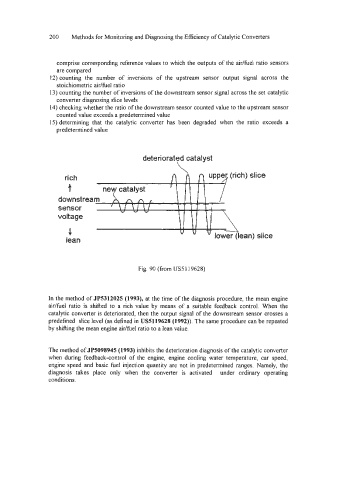
                                           Fig. 90 (from US5 1 19628)


                In the method of JP5312025 (1993), at the time of the diagnosis procedure, the mean  engine
                air/fuel ratio is  shifted to  a rich  value by  means  of a  suitable feedback control. When  the
                catalytic converter is deteriorated, then the output signal of the downstream sensor crosses a
                predefined  slice level (as defined in US5119628 (1992)). The same procedure can be repeated
                by shifting the mean engine aidfuel ratio to a lean value.


                The method of JP5098945 (1993) inhibits the deterioration diagnosis of the catalytic converter
                when  during feedback-control of  the  engine,  engine  cooling water  temperature, car  speed,
                engine speed and  basic fuel  injection  quantity are not in  predetermined ranges. Namely,  the
                diagnosis  takes  place  only  when  the  converter  is  activated  under  ordinary  operating
                conditions.

