


Page 222 - Methods For Monitoring And Diagnosing The Efficiency Of Catalytic Converters A Patent - oriented Survey
P. 222
204    Methods for Monitoring and Diagnosing the Efficiency of Catalytic Converters


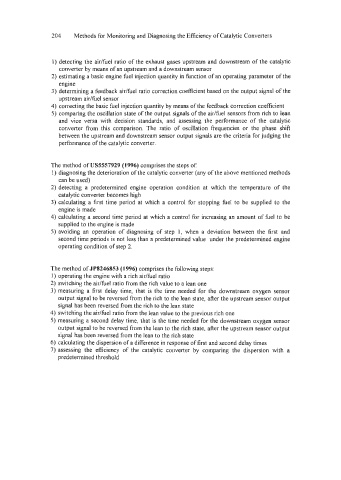
                 1)  detecting the aidfuel ratio of the exhaust gases upstream and downstream of the catalytic
                   converter by means of an upstream and a downstream sensor
                2) estimating a basic engine fuel injection quantity in function of an operating parameter of the
                   engine
                3) determining a feedback aidfuel ratio correction coefficient based on the output signal of the
                   upstream aidfuel sensor
                4)  correcting the basic fuel injection quantity by means of the feedback correction coefficient
                5) comparing the oscillation state of the output signals of the aidfuel sensors from rich to lean
                   and  vice  versa  with  decision  standards,  and  assessing the  performance of  the  catalytic
                   converter from  this  comparison. The  ratio  of  oscillation frequencies or  the  phase  shift
                   between the upstream and downstream sensor output signals are the criteria for judging the
                   performance of the catalytic converter.


                The method of 085557929 (1 996) comprises the steps of
                 1)  diagnosing the deterioration of the catalytic converter (any of the above mentioned methods
                   can be used)
                2) detecting a  predetermined engine operation  condition  at  which  the  temperature  of  the
                   catalytic converter becomes high
                3) calculating a first time period  at  which  a control for stopping fuel to be  supplied to  the
                   engine is made
                4) calculating a second time period  at which a control for increasing an  amount of fuel to be
                   supplied to the engine is made
                5) avoiding an operation  of  diagnosing of  step  1,  when  a  deviation between  the  first  and
                   second time periods is not less than a predetermined value  under the predetermined engine
                   operating condition of step 2.


                The method of JP8246853 (1996) comprises the following steps:
                 1)  operating the engine with a rich air/hel ratio
                2) switching the air/hel ratio from the rich value to a lean one
                3) measuring a first delay time,  that  is the time  needed  for the  downstream oxygen  sensor
                  output signal to be reversed from the rich to the lean state, after the upstream sensor output
                   signal has been reversed from the rich to the lean state
                4) switching the air/fuel ratio from the lean value to the previous rich one
                5) measuring a second delay time, that is the time needed for the downstream oxygen sensor
                  output signal to be reversed from the lean to the rich state, after the upstream sensor output
                   signal has been reversed from the lean to the rich state
                6) calculating the dispersion of a difference in response of first and second delay times
                7) assessing the  efficiency of  the  catalytic  converter  by  comparing the  dispersion  with  a
                  predetermined threshold

