


Page 219 - Methods For Monitoring And Diagnosing The Efficiency Of Catalytic Converters A Patent - oriented Survey
P. 219
Nissan Motor Co. Ltd.                     20 1


                                            1


                                 catalyst
                                 diagnosing
                                 slice level


                                                               amplitude
                                                              period


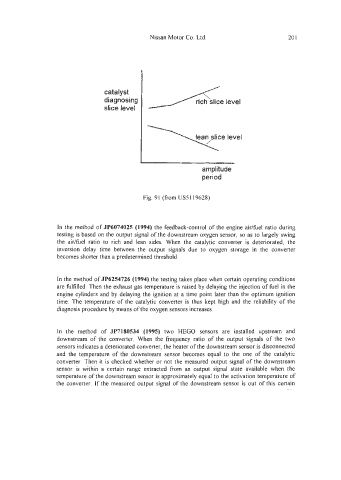
                                             Fig. 91 (from US5 I 19628)


                   In the method  of JP6074025 (1994) the feedback-control  of the engine air/hel ratio during
                  testing is based on the output signal of the downstream oxygen sensor, so as to largely swing
                  the  airlfbel  ratio  to  rich  and  lean  sides.  When  the  catalytic  converter  is  deteriorated,  the
                  inversion  delay  time  between  the  output  signals  due  to  oxygen  storage  in  the  converter
                  becomes shorter than a predetermined threshold.


                  In the method of JP6254726 (1994) the testing takes place when certain operating conditions
                  are fulfilled. Then the exhaust gas temperature is raised by delaying the injection of fuel in the
                  engine cylinders and by delaying the ignition at  a time point later than  the optimum ignition
                  time.  The temperature  of the  catalytic converter  is thus  kept  high  and the reliability of the
                  diagnosis procedure by means of the oxygen sensors increases.


                  In  the  method  of  JP7180534 (1995) two  HEGO  sensors  are  instailed  upstream  and
                  downstream  of the  converter.  When  the  tfequency  ratio  of the  output  signals  of the  two
                  sensors indicates a deteriorated converter, the heater of the downstream sensor is disconnected
                  and  the  temperature  of the  downstream  sensor  becomes  equal  to the  one  of the  catalytic
                  converter. Then it  is checked whether or not  the measured  output  signal of the downstream
                  sensor  is  within  a  certain  range  extracted  from  an  output  signal  state  available  when  the
                  temperature of the downstream sensor is approximately equal to the activation temperature of
                  the converter.  If  the measured  output  signal of the  downstream  sensor is out  of this  certain

