


Page 245 - Methods For Monitoring And Diagnosing The Efficiency Of Catalytic Converters A Patent - oriented Survey
P. 245
Other Methods                         227


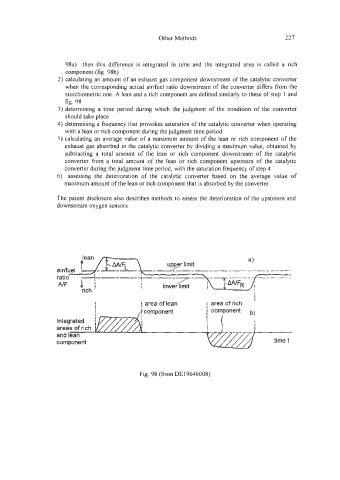
                     98a)  then  this  difference is  integrated  in  time  and  the  integrated  area  is  called  a  rich
                     component (fig. 98b)
                   2) calculating an amount of an exhaust gas component  downstream of the catalytic converter
                     when the corresponding actual aidfuel ratio downstream of the converter differs from  the
                     stoichiometric one. A lean and a rich component are defined similarly to these of step 1  and
                     fig. 98
                   3) determining a time  period  during which  the judgment  of the  condition of  the  converter
                     should take place
                   4) determining a frequency that provokes saturation of the catalytic converter when operating
                     with a lean or rich component during the judgment time period
                   5) calculating an  average value  of a maximum  amount  of the lean or rich  component of the
                     exhaust gas absorbed in the catalytic converter by  dividing a maximum value,  obtained by
                     subtracting a  total  amount of  the  lean  or  rich  component downstream  of  the  catalytic
                     converter from  a total  amount  of the  lean  or  rich  component upstream  of  the  catalytic
                     converter during the judgment time period, with the saturation frequency of step 4
                  6)  assessing  the  deterioration of  the  catalytic  converter based  on  the  average  value  of
                     maximum amount of the lean or rich component that is absorbed by the converter

                  The patent disclosure also describes methods to assess the deterioration of the upstream and
                  downstream oxygen sensors.


                                                                                   - e
                   NF    J.-'----- rich I   '
                                            I
                                                                              I
                                            I  area of lean     I  areaofrich
                                             component          I component   b)
                  Integrated                                    i /
                  areas of rich y//////A    I                                 I
                  and lean
                                                                           //
                  component                                     W/L                 timet


                                           Fig. 98 (from DE19646008)

