


Page 241 - Methods For Monitoring And Diagnosing The Efficiency Of Catalytic Converters A Patent - oriented Survey
P. 241
Other Methods                         223


                   the left bank  of cylinders. The detected output signals of the downstream sensor and the left
                   bank  upstream oxygen  sensor are then  used  for the  assessment of the  secondary catalytic
                   converter installed  in  the left  exhaust branch  as well  as of the main  catalytic converter. The
                   same procedure is repeated for the right bank of cylinders.


                   The method  of JP8135432 (1996) is applied  in  an  engine  layout with  two  cylinder  banks
                  similar to the one described in the JP7063045 (1995) (fig. 38).  First it is evaluated which of
                  the two upstream sensors has the fastest response (e.g. the left bank upstream oxygen sensor).
                  The ratio of the number of reversals of the output signal of the upstream sensor with the fastest
                  response and of the number of reversals of the output signal of the downstream sensor is then
                  formed. The deterioration diagnosis of the catalytic converter is carried out by judging whether
                  this ratio is lower than a specific threshold.


                     FE V Motorentechnik GmbN & Co.


                  The method of DE4019572 (1992) monitors the fknctionality of a catalytic converter, engine
                  misfiring and/or variable injection. It uses two sensors placed in the exhaust path. One of the
                  sensors has a catalytic activity. The difference in the outputs of the signals of the two sensors,
                  provoked by the change in temperature when the HC/air mixtures react with the catalyst of one
                  of the sensors, gives an  indication  of the condition of the converter and the misfiring of the
                  engine. Oxygen sensors can be installed upstream and downstream of the converter.


                     Hyundai Motor Co.


                  The method of W09628646 (1996) comprises the following steps:
                  1)  determining if a certain time of operation of the engine has elapsed, in order to prevent an
                    erroneous judgment
                  2) setting rich and lean adjusting parameters ki for an engine aidfuel ratio after the certain
                    time has elapsed
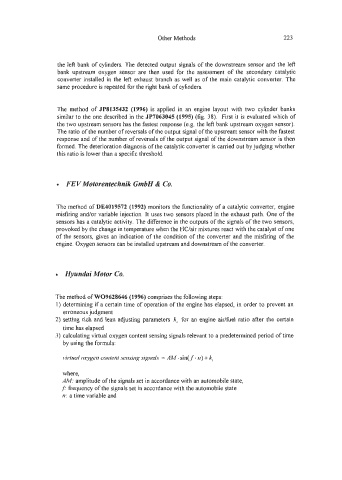
                  3) calculating virtual oxygen content sensing signals relevant to a predetermined period of time
                    by using the formula:


                    where,
                    AM: amplitude of the signals set in accordance with an automobile state,
                    .f: frequency of the signals set in accordance with the automobile state
                    11:  a time variable and

