


Page 261 - Methods For Monitoring And Diagnosing The Efficiency Of Catalytic Converters A Patent - oriented Survey
P. 261
Emitec Gesellschafi fiir Emissionstechnologie - Dr. Ing. H.c.F. Porsche AG   243


                   The temperature sensors can have the form of fig. 102 or can be mounted on a jacket surface
                   of the catalytic converter (fig.  103). This version is advantageous because it does not require
                   any alterations in the interior of the catalytic converter.

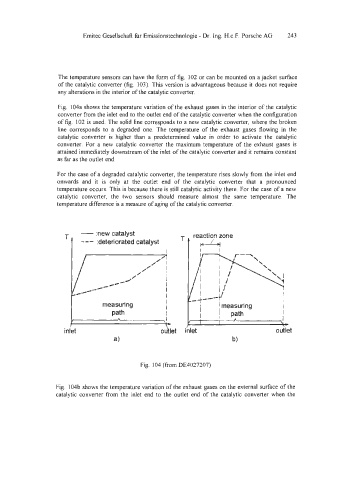
                   Fig.  104a shows the temperature variation  of the exhaust gases in the interior of the catalytic
                  converter from the inlet end to the outlet end of the catalytic converter when the configuration
                  of fig. 102 is used. The solid line corresponds to a new catalytic converter, where the broken
                  line  corresponds to  a  degraded one. The temperature of the  exhaust gases flowing in  the
                  catalytic converter is  higher  than  a  predetermined  value  in  order  to  activate the  catalytic
                  converter. For a new  catalytic converter the  maximum temperature of the exhaust gases is
                  attained immediately downstream of the inlet of the catalytic converter and it remains constant
                  as far as the outlet end.

                  For the case of a degraded catalytic converter, the temperature rises slowly from the inlet end
                  onwards  and  it  is  only  at  the  outlet  end  of  the  catalytic  converter  that  a  pronounced
                  temperature occurs. This is because there is still catalytic activity there. For the case of a new
                  catalytic  converter,  the  two  sensors  should  measure  almost  the  same  temperature.  The
                  temperature difference is a measure of aging of the catalytic converter.


                         - :new catalyst
                     T                                     reaction zone
                         --- :deteriorated catalyst
                                                   I          I    I
                                               /’  1
                                                  /
                                            //  ’
                                         /’        I  I
                                     rc/           I
                      1         measuring          f         1  I   1 measuring        I  I
                                                   I
                                                                   I
                                                                       path
                                   pa!h
                                                   I
                                                   ,\              I    fi.           1  7-
                    inlet                         outlet  inlet                     outlet


                                           Fig.  104 (from DE4027207)


                  Fig.  104b shows the temperature variation of the exhaust gases on the external surface of the
                  catalytic converter from  the  inlet  end  to the  outlet end  of  the catalytic converter when  the

