


Page 266 - Methods For Monitoring And Diagnosing The Efficiency Of Catalytic Converters A Patent - oriented Survey
P. 266
248   Methods for Monitoring and Diagnosing the Eficiency of Catalytic Converters


                           c) the concentration of nitrogen oxides in the exhaust gases entering the catalytic
                             converter, or
                           d) a combination of the operation parameters described in a)-c)
                 3) measuring  the  variation  of the  exhaust  gas temperature  inside the  catalytic  converter  in
                   space or in time from the normal condition to the new conditions imposed
                 4) determining the degree of deterioration of the catalytic converter based on the behavior of
                   the measured temperature variation.
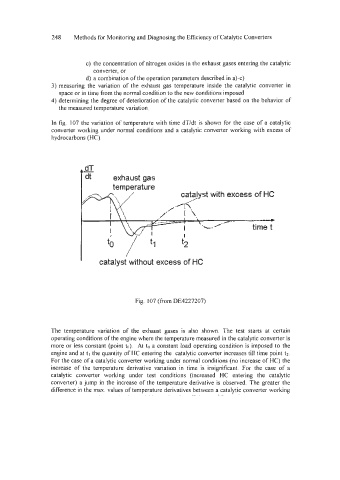
                 In fig.  107 the variation of temperature with time dT/dt  is shown for the case of a  catalytic
                 converter working under normal conditions and a catalytic converter working  with excess of
                 hydrocarbons (HC).


                          -
                           dT
                           dt      exhaust gas
                                   temperature
                                                        catalyst with excess of HC
                                                      4

                                                  *  '  *  ,  I \*                 _.
                                                             '*<7
                                  I
                                                                                   t
                                                                              time
                         '                               I

                                       /
                               catalyst without excess of HC


                                          Fig. 107 (from DE4227207)


                The  temperature  variation  of  the  exhaust  gases  is  also  shown.  The  test  starts  at  certain
                operating conditions of the engine where the temperature measured in the catalytic converter is
                more or less constant  (point to).  At to  a constant  load operating condition is imposed to the
                engine and at tl the quantity of HC entering the  catalytic converter increases till time point t2.
                For the case of a catalytic converter working under normal conditions (no increase of HC) the
                increase  of  the  temperature  derivative  variation  in  time  is  insignificant. For  the  case of a
                catalytic  converter  working  under  test  conditions  (increased  HC  entering  the  catalytic
                converter) a jump  in the increase of the temperature derivative is observed. The greater  the
                difference in the max. values of temperature derivatives between a catalytic converter working

