


Page 268 - Methods For Monitoring And Diagnosing The Efficiency Of Catalytic Converters A Patent - oriented Survey
P. 268
250    Methods for Monitoring and Diagnosing the Eficiency of Catalytic Converters


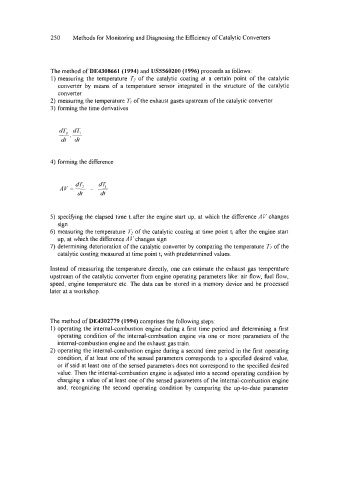
                The method of DE4308661 (1994) and US5560200 (1996) proceeds as follows:
                1) measuring the  temperature 7;  of the catalytic coating at  a  certain point  of the  catalytic
                  converter by  means  of  a temperature sensor integrated  in  the  structure of the  catalytic
                  converter
                2) measuring the temperature TI of the exhaust gases upstream of the catalytic converter
                3) forming the time derivatives


                   dT,  dT,
                   --
                   dt  ’ dt


                4) forming the difference


                5) specifying the elapsed time ti after the engine start up,  at which the difference AV changes
                  sign
                6) measuring the temperature 72 of the catalytic coating at time point ti after the engine start
                  up, at which the difference  A V changes sign
                7) determining deterioration of the catalytic converter by comparing the temperature Tz of the
                  catalytic coating measured at time point ti with predetermined values.
                Instead of measuring the temperature directly, one can estimate the exhaust gas temperature
                upstream of the catalytic converter from engine operating parameters like: air flow, fuel flow,
                speed, engine temperature etc. The data can be stored in  a memory device and be processed
                later at a workshop.


                The method of DE4302779 (1 994) comprises the following steps:
                1)  operating the internal-combustion engine during a first time period and  determining a first
                  operating condition of the internal-combustion engine via  one or more parameters of the
                  internal-combustion engine and the exhaust gas train.
                2) operating the internal-combustion engine during a second time period in the first operating
                  condition, if at least one of the sensed parameters corresponds to a specified desired value,
                  or if said at least one of the sensed parameters does not correspond to the specified desired
                  value. Then the internal-combustion engine is adjusted into a second operating condition by
                  changing a value of at least one of the sensed parameters of the internal-combustion engine
                  and,  recognizing the  second  operating condition by  comparing the up-to-date  parameter

