


Page 279 - Methods For Monitoring And Diagnosing The Efficiency Of Catalytic Converters A Patent - oriented Survey
P. 279
Robert Bosch GmbH                         26 1


                   1)  operating the engine under such conditions that the temperature of the catalytic converter
                      is lower than the activation temperature of a new converter
                   2)  measuring the time interval At to reach a predetermined  temperature, which is higher than
                      the activation temperature of a new catalytic converter
                   3)  comparing the measured time interval At  with a predetermined value At0
                   4)  determining that the catalytic converter is hnctional  when the measured time interval At  is
                      smaller than the predetermined value At0

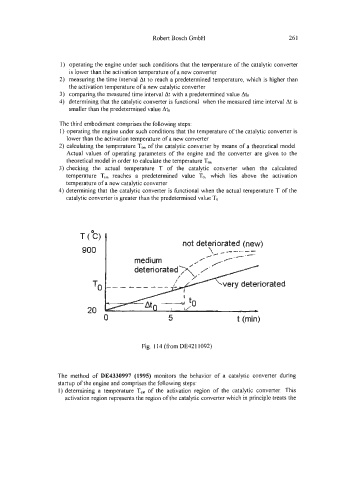
                   The third embodiment comprises the following steps:
                   1)  operating the engine under such conditions that the temperature of the catalytic converter is
                     lower than the activation temperature of a new converter
                   2) calculating the temperature Tt,  of the catalytic converter by  means of a theoretical model.
                     Actual  values of  operating parameters of  the  engine  and  the  converter are given  to  the
                     theoretical model in order to calculate the temperature T,,
                   3) checking  the  actual  temperature  T  of  the  catalytic  converter  when  the  calculated
                     temperature  T,,,,  reaches  a  predetermined  value  To,  which  lies  above  the  activation
                     temperature of a new catalytic converter
                   4) determining that the catalytic converter is hnctional when the actual temperature T of the
                     catalytic converter is greater than the predetermined value TO


                                                         not deteriorated (new)
                                                         not deteriorated
                                                                           (new)
                          900


                                                                     very
                                                                     very deteriorated
                                                                          deteriorated


                                 0                  5  5                 t (min)
                                                                           (min)
                                                                         t
                                 0
                                            Fig. 1 I4 (from DE42 1 1092)


                   The  method  of  DE4330997 (1995) monitors the  behavior  of  a  catalytic converter during
                   startup of the engine and comprises the following steps:
                   1)  determining a  temperature T,,  of  the  activation region  of  the  catalytic  converter.  This
                     activation region represents the region of the catalytic converter which in principle treats the

