


Page 281 - Methods For Monitoring And Diagnosing The Efficiency Of Catalytic Converters A Patent - oriented Survey
P. 281
Robert Bosch GmbH                        263


                   Fig.  1 15 shows the variation of temperature Tcal of the activation region with time for a new, a
                  medium  deteriorated and  a fully  deteriorated catalytic converter. During  testing, the  engine
                  idles and the catalytic converter is fully warmed-up. For t<to, T,,,  is constant (=Ta,,,)  and it is
                  the same for all three converters. From  time point  to  till  time point  tl  an  airhe1 mixture is
                  added to the catalytic converter. The measured temperature variation from point  to  onwards
                  depends then on the condition of the catalytic converter. At time point to  the increase of Tal is
                  steeper for new catalytic converters than for aged ones. Additionally the maximum temperature
                  observed in the activation region is higher for new  catalytic converters than  aged ones. That
                  means  that  the new  catalytic converter converts higher  quantities of  aidfuel mixture in  the
                  activation region, it  releases higher  heat  energy and  warms up  the catalytic converter faster
                  than  when  the  catalytic converter is  aged. The  slope of the  curve  i.e. the  first  or  second
                  derivative of Tal and the difference of Tal from a reference temperature T,f  can be a measure
                  of the efficiency of the activation region  of the catalytic converter. At tl  the addition of the
                  aidfuel mixture stops and the temperature of the three converters returns to value T,,,   which
                  they had before heating them up.


                                        catalytic converter
                                                        I


                                             evalua t i on
                                                 unit


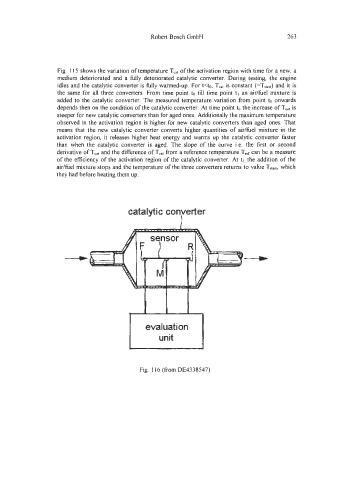
                                           Fig. 116 (from DE4338547)

