


Page 278 - Methods For Monitoring And Diagnosing The Efficiency Of Catalytic Converters A Patent - oriented Survey
P. 278
260    Methods for Monitoring and Diagnosing the Efficiency of Catalytic Converters


                                                -X

                                                     T


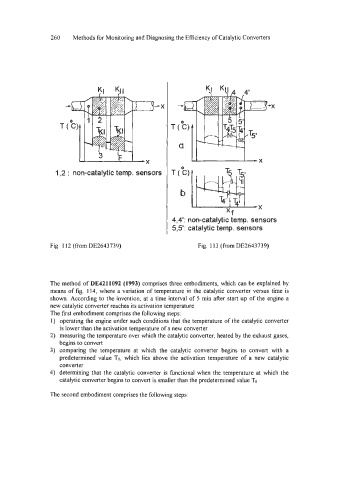
                  1,2 : non-catalytic temp. sensors


                                                        b
                                                                               X
                                                                      Xf
                                                     4,4': non-catalytic temp. sensors
                                                     53: catalytic temp. sensors


                Fig. 1 12 (from DE2643739)                   Fig. 113 (from DE2643739)


                The method  of DE4211092 (1993) comprises three embodiments, which can be explained by
                means of fig.  114, where a variation  of temperature in the catalytic converter versus time is
                shown. According to the invention, at  a time interval of 5  min  after start up of the engine a
                new catalytic converter reaches its activation temperature.
                The first embodiment comprises the following steps:
                   operating the engine under such conditions that the temperature of the catalytic converter
                   is lower than the activation temperature  of a new converter
                   measuring the temperature over which the catalytic converter, heated by the exhaust gases,
                   begins to convert
                   comparing the  temperature at  which  the  catalytic converter begins  to  convert  with  a
                   predetermined value To,  which  lies  above the  activation temperature of  a new  catalytic
                   converter
                   determining that the catalytic converter is fhctional  when  the temperature at which the
                   catalytic converter begins to convert is smaller than the predetermined value To

                The second embodiment comprises the following steps:

