


Page 251 - Microtectonics
P. 251
242   8  ·  Primary Structures
                     In metatexites it can often be observed, on the mesoscopic  parallel and the later one may progressively erase the
                   scale, that competent parts of the rock, like calc-silicate or  earlier one. A special case where C/S fabrics have the same
                   amphibolite layers, are fractured or boudinaged with leuco-  orientation and sense of shear as inferred magmatic flow
                   somes (melt) concentrated in fractures or necks of boudins.  imbrication of the same minerals, may strongly suggest
                                                                that the deformation was continuous from the magmatic
                   Presence of Late Magmatic Minerals in Strain Shadows  to the solid state and that therefore at least part of it was
                                                                by submagmatic flow.
                   If it can be demonstrated that the infill of dilatational
                   sites other than cracks or microfractures is of magmatic  8.2.4
                   nature and not precipitated from an aqueous fluid, this  Evidence for Solid State Deformation
                   is a strong argument for submagmatic deformation (e.g.
                   Bouchez et al. 1992).                        It has been argued that “solid state” is not an appropriate
                     The problem in proving submagmatic flow is that it is  term since there is usually a liquid present and that “non-
                   often difficult to demonstrate that crystal deformation  magmatic” deformation might be a better choice (Blen-
                   was contemporaneous with presence of melt. The natu-  kinsop 2000). However, we prefer to continue the usage
                   ral evolution of most crystallising plutons in a stress field  of the term “solid state” since it is well established and
                   would imply submagmatic flow followed by solid state  also widely used for metamorphic processes where the
                   flow and in such cases it may be difficult to separate crys-  same restriction holds.
                   tal plastic deformation features that were generated dur-  In the context of distinguishing between magmatic,
                   ing submagmatic flow from similar structures generated  submagmatic and solid state deformation it is interest-
                   later when the rock was fully crystallised. In some cases  ing to review briefly the principal lines of evidence for
                   a clear angular overprint relation can be observed be-  solid state deformation (Vernon 2000; Blenkinsop 2000):
                   tween an earlier magmatic foliation (e.g. as aligned elon-
                   gated enclaves or rectangular phenocrysts) and a later  1. internal deformation often visible as undulose extinc-
                   solid-state foliation (e.g. Vernon 2000, his Fig. 19). In  tion, formation of subgrains and recrystallisation into
                   other cases the two superposed foliations may be sub-  smaller grains (compare Chap. 3);


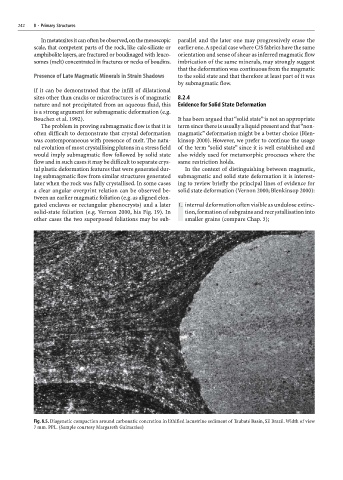
                   Fig. 8.5. Diagenetic compaction around carbonatic concretion in lithified lacustrine sediment of Taubaté Basin, SE Brazil. Width of view
                   7 mm. PPL. (Sample courtesy Margareth Guimarães)

