


Page 250 - Microtectonics
P. 250
8.2  ·  Primary Structures in Rocks of Igneous Origin or in Migmatites  241


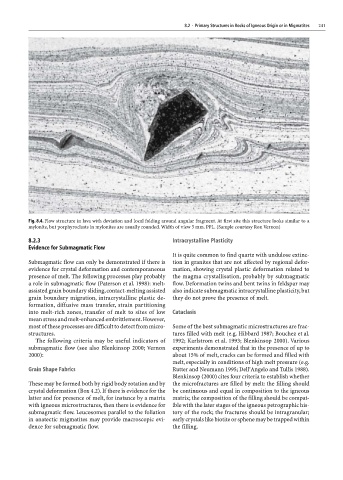
                 Fig. 8.4. Flow structure in lava with deviation and local folding around angular fragment. At first site this structure looks similar to a
                 mylonite, but porphyroclasts in mylonites are usually rounded. Width of view 5 mm. PPL. (Sample courtesy Ron Vernon)

                 8.2.3                                         Intracrystalline Plasticity
                 Evidence for Submagmatic Flow
                                                               It is quite common to find quartz with undulose extinc-
                 Submagmatic flow can only be demonstrated if there is  tion in granites that are not affected by regional defor-
                 evidence for crystal deformation and contemporaneous  mation, showing crystal plastic deformation related to
                 presence of melt. The following processes play probably  the magma crystallisation, probably by submagmatic
                 a role in submagmatic flow (Paterson et al. 1998): melt-  flow. Deformation twins and bent twins in feldspar may
                 assisted grain boundary sliding, contact-melting assisted  also indicate submagmatic intracrystalline plasticity, but
                 grain boundary migration, intracrystalline plastic de-  they do not prove the presence of melt.
                 formation, diffusive mass transfer, strain partitioning
                 into melt-rich zones, transfer of melt to sites of low  Cataclasis
                 mean stress and melt-enhanced embrittlement. However,
                 most of these processes are difficult to detect from micro-  Some of the best submagmatic microstructures are frac-
                 structures.                                   tures filled with melt (e.g. Hibbard 1987; Bouchez et al.
                   The following criteria may be useful indicators of  1992; Karlstrom et al. 1993; Blenkinsop 2000). Various
                 submagmatic flow (see also Blenkinsop 2000; Vernon  experiments demonstrated that in the presence of up to
                 2000):                                        about 15% of melt, cracks can be formed and filled with
                                                               melt, especially in conditions of high melt pressure (e.g.
                 Grain Shape Fabrics                           Rutter and Neumann 1995; Dell’Angelo and Tullis 1988).
                                                               Blenkinsop (2000) cites four criteria to establish whether
                 These may be formed both by rigid body rotation and by  the microfractures are filled by melt: the filling should
                 crystal deformation (Box 4.2). If there is evidence for the  be continuous and equal in composition to the igneous
                 latter and for presence of melt, for instance by a matrix  matrix; the composition of the filling should be compat-
                 with igneous microstructures, then there is evidence for  ible with the later stages of the igneous petrographic his-
                 submagmatic flow. Leucosomes parallel to the foliation  tory of the rock; the fractures should be intragranular;
                 in anatectic migmatites may provide macroscopic evi-  early crystals like biotite or sphene may be trapped within
                 dence for submagmatic flow.                   the filling.

