


Page 252 - Microtectonics
P. 252
8.3  ·  Primary Structures in Sedimentary Rocks  243
                 2. recrystallised wings on deformed grains or porphy-  8.3                                    8.3
                   roclasts; these are particularly common in augen gneisses  Primary Structures in Sedimentary Rocks
                   and mylonites (see Chap. 5);
                 3. elongation, usually in LS shape fabrics, of recrystal-  Bedding, diagenetic foliation and tectonic foliation may
                   lised aggregates (e.g. of quartz and mica) is very com-  be transitional structures and criteria to distinguish be-
                   mon in deformed granitic rocks;             tween them are given in Chap. 4. Slump folding and con-
                 4. prism <c> slip in quartz, recognised by quartz c-axes  volute bedding may be confused with tectonic structures
                   with a preferred orientation close to the stretching  of an early folding phase, but microstructural evidence
                   lineation (e.g. Law et al. 1992; Lagarde et al. 1994);  is rarely conclusive in these cases. Compaction structures
                 5. fine grained foliation(s) anastomosing around less  around concretions in sediments that are not tectonically
                   deformed lenses or porphyroclasts, reflecting hete-  deformed may resemble tectonic deformation (Fig. 8.5)
                   rogeneous strain; they may constitute C/S fabrics  and irregular lenses of coarser sediment in a finer grained
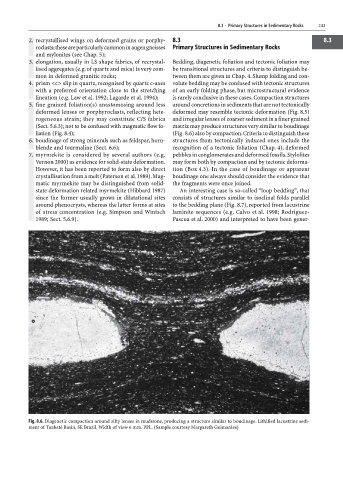
                   (Sect. 5.6.3); not to be confused with magmatic flow fo-  matrix may produce structures very similar to boudinage
                   liation (Fig. 8.4);                         (Fig. 8.6) also by compaction. Criteria to distinguish these
                 6. boudinage of strong minerals such as feldspar, horn-  structures from tectonically induced ones include the
                   blende and tourmaline (Sect. 6.6);          recognition of a tectonic foliation (Chap. 4), deformed
                 7. myrmekite is considered by several authors (e.g.  pebbles in conglomerates and deformed fossils. Stylolites
                   Vernon 2000) as evidence for solid-state deformation.  may form both by compaction and by tectonic deforma-
                   However, it has been reported to form also by direct  tion (Box 4.3). In the case of boudinage or apparent
                   crystallisation from a melt (Paterson et al. 1989). Mag-  boudinage one always should consider the evidence that
                   matic myrmekite may be distinguished from solid-  the fragments were once joined.
                   state deformation related myrmekite (Hibbard 1987)  An interesting case is so-called “loop bedding”, that
                   since the former usually grows in dilatational sites  consists of structures similar to isoclinal folds parallel
                   around phenocrysts, whereas the latter forms at sites  to the bedding plane (Fig. 8.7), reported from lacustrine
                   of stress concentration (e.g. Simpson and Wintsch  laminite sequences (e.g. Calvo et al. 1998; Rodriguez-
                   1989; Sect. 5.6.9).                         Pascua et al. 2000) and interpreted to have been gener-


                 Fig. 8.6. Diagenetic compaction around silty lenses in mudstone, producing a structure similar to boudinage. Lithified lacustrine sedi-
                 ment of Taubaté Basin, SE Brazil. Width of view 6 mm. PPL. (Sample courtesy Margareth Guimarães)

