


Page 231 - MODELING OF ASPHALT CONCRETE
P. 231
Unified Disturbed State Constitutive Modeling of Asphalt Concr ete      209


                    by Bonaquist (1996) and Bonaquist and Witczak (1997). This chapter contains the DSC
                    model, which includes the HISS model as a special case. It is considered to be unified
                    and economical compared to other models currently available.


               Objective
                    The main objective of this chapter is to present a full mechanistic approach with the
                    powerful and unified constitutive models based on the disturbed state concept (DSC)
                    that has been already developed, and can be readily used for modeling asphalt concrete
                    and pavement applications. Before the presentation of the DSC models and associated
                    two- and three-dimensional codes for the treatment of various distresses, a brief review
                    of some of the available models is first presented.

                    Review of RM Approach
                    The resilient modulus (RM) approach has been used extensively in pavement engineering
                    (Witczak and Uzan 1988; Barksdale et al. 1990; Huang 1993). Although it can provide
                    satisfactory predictions of elastic uniaxial displacements, it is not capable of predicting
                    the foregoing multidimensional effects such as rutting, microcracking, and fracture.
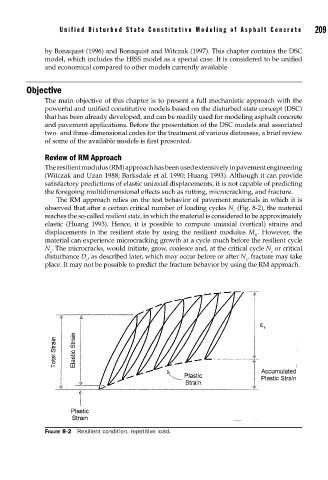
                       The RM approach relies on the test behavior of pavement materials in which it is
                    observed that after a certain critical number of loading cycles N  (Fig. 8-2), the material
                                                                         c
                    reaches the so-called resilient state, in which the material is considered to be approximately
                    elastic (Huang 1993). Hence, it is possible to compute uniaxial (vertical) strains and
                    displacements in the resilient state by using the resilient modulus  M . However, the
                                                                               R
                    material can experience microcracking growth at a cycle much before the resilient cycle
                    N . The microcracks, would initiate, grow, coalesce and, at the critical cycle N  or critical
                      c                                                             c
                    disturbance D , as described later, which may occur before or after N , fracture may take
                                c                                            c
                    place. It may not be possible to predict the fracture behavior by using the RM approach.


                    FIGURE 8-2  Resilient condition, repetitive load.

