


Page 371 - Modern Control Systems
P. 371
Section 5.9  Design  Examples                                       345
                            The  goal  of the  design  is to choose  K t  and  K  so that  (1)  the percent  overshoot
                        of the  output  to  a step command, r{i), is less than  or  equal  to  10%, (2)  the  steady-
                        state error to a ramp command  is minimized, and  (3) the  effect  of a step  disturbance
                        is reduced. Since the system has an inner loop, block diagram reduction  can be  used
                        to obtain  the simplified  system  of Figure  5.34(b).
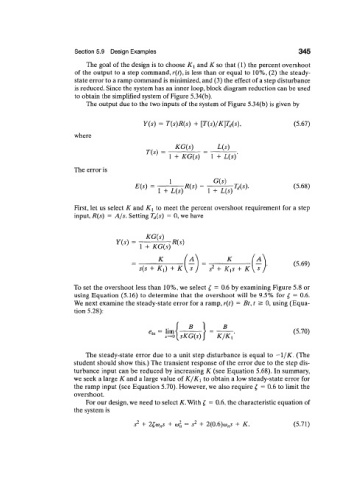
                           The output  due to the two inputs  of the system  of Figure 5.34(b)  is given  by

                                             Y(s)  =  T(s)R(s)  +  [T(s)/K]T d(s),         (5.67)

                        where
                                                       KG(s)        L(s)
                                              T(s)  =
                                                     1  +  KG(s)  1  +  L(s)'
                        The error  is


                        First, let  us select  K  and  K± to  meet  the  percent  overshoot  requirement  for  a  step
                        input, R(s)  =  A/s.  Setting T d(s)  =  0, we  have


                                              KG(s)


                                                 K         A\         K         A
                                                                                           (5.69)
                                            s(s  +  K{)  +  K\s  J  s 2  +  Kis  +  K\s

                        To set  the  overshoot  less than  10%, we select  £  =  0.6 by examining Figure  5.8  or
                        using Equation  (5.16)  to  determine  that  the  overshoot  will  be  9.5%  for  I  =  0.6.
                        We next  examine the steady-state  error for  a ramp, r{i)  =  Bt,t  >:  0, using  (Equa-
                        tion  5.28):

                                                 =
                                                                 =
                                               *•  Jajfefe)}  m-                           (570)

                           The  steady-state  error  due  to  a  unit  step  disturbance  is equal  to  -1/K.  (The
                        student  should  show  this.) The  transient  response  of  the  error  due  to  the step dis-
                        turbance  input  can be reduced  by increasing  K  (see Equation  5.68). In  summary,
                        we seek  a large  K  and  a large value  of  KjK\  to obtain  a low steady-state  error  for
                        the ramp input  (see Equation  5.70). However, we also require  £  =  0.6  to limit  the
                        overshoot.
                           For our design, we need  to select K. With £  =  0.6, the characteristic equation  of
                        the system is
                                          s 2  +  2£<o„s  +  oil  =  s 2  +  2(0.6)w„.v  +  K.  (5.71)

