


Page 366 - Modern Control Systems
P. 366
340              Chapter 5  The Performance of Feedback Control Systems

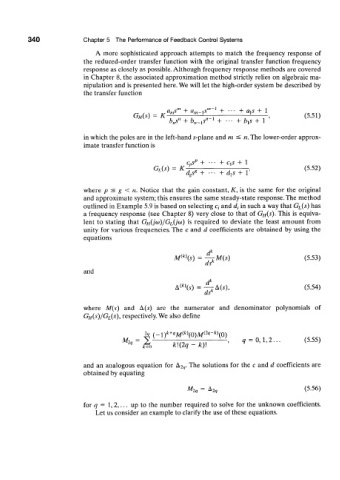
                              A  more  sophisticated  approach  attempts  to match  the frequency  response  of
                           the  reduced-order  transfer  function  with  the original  transfer  function  frequency
                           response  as closely as possible. Although  frequency  response methods are covered
                           in Chapter  8, the associated  approximation  method  strictly  relies on algebraic ma-
                           nipulation  and is presented  here. We  will let the high-order  system be described  by
                           the transfer  function

                                                                n l
                                                    a ms m  +  a m- iS' ~  +  •••  + 0 ^  +  1
                                          GH(S)  =  K"; n  n  ,  7  ,,_!  ,  r^T^i            (5.51)
                                                                 1
                                                     b ns  + 6,,-is""  +  •••  +  b xs  + 1
                           in which the poles are in the left-hand  s-plane  and m  ^  n. The lower-order  approx-
                           imate transfer  function  is

                                                             p
                                                          C nS  +  •••  +  C]S +  1
                                                G L(s)  =  K^—-                               (5.52)


                           where  p  <  g  <  n. Notice  that  the gain  constant,  K,  is the  same  for  the  original
                           and approximate system; this ensures the same steady-state response. The  method
                           outlined in Example  5.9 is based on selecting  C/ and d L in such a way that  G L{s) has
                           a  frequency  response  (see Chapter  8) very  close  to that  of  G H{s).  This  is  equiva-
                           lent  to  stating  that  G H(j<o)/G L(j<o) is required  to  deviate  the  least  amount  from
                           unity  for various  frequencies. The c and d  coefficients  are obtained  by using the
                           equations

                                                                d k
                                                        (k
                                                      M \s)  =-^   M(s)                       (5.53)
                                                               dsr
                           and
                                                        (
                                                      A * t o ^ A ( j ) ,                    (5.54)
                                                               ds k
                           where  M(s)  and  A ( J ) are  the  numerator  and  denominator  polynomials  of
                           G H(s)/G L(s),  respectively. We also  define

                                             2,  ( - l f # > ( Q ) M ^ - ^ ( Q )
                                      M  =                                   =     2             5 55
                                        *  S         *,<2*-*)!        '   *    °^  • * *        ( - >


                           and  an analogous  equation  for  A 2f/. The solutions  for the c and d  coefficients  are
                           obtained by equating

                                                              =                               (5.56)
                                                          M lq  A 2/?
                           for  q  = 1,2,...  up to the number  required  to solve  for the unknown  coefficients.
                              Let us consider  an example to clarify  the use of these  equations.

