


Page 365 - Modern Control Systems
P. 365
Section 5.8  The Simplification of  Linear Systems                   339

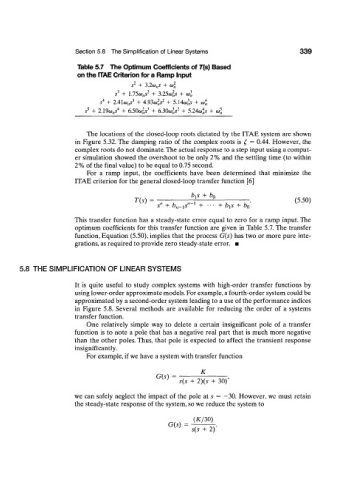
                         Table 5.7  The Optimum Coefficients of T(s) Based
                         on the ITAE Criterion for a Ramp Input
                                                      2
                                         s 2  +  3.2(o ns  +  (o T
                                              2
                                    5 3  +  1.75co ;i s  +  325afe  +  a? n
                                5 4  +  2Al(o„s 3  + 4.93cols 2  +  5.14w;V  +  w 4
                                                               4
                                              2
                           5 5  +  2.19(0,/  + 6.5Q(o / +  6.30<ojy  +  5.24co s  +  cof,
                            The locations  of  the  closed-loop  roots dictated  by the ITAE  system are  shown
                        in  Figure  5.32. The  damping  ratio  of  the  complex  roots  is  £  =  0.44.  However,  the
                        complex roots do not dominate. The actual response to a step input  using a comput-
                        er  simulation  showed  the  overshoot  to be  only 2%  and  the  settling  time  (to  within
                        2%  of the final  value) to be equal to 0.75  second.
                            For  a  ramp  input,  the  coefficients  have  been  determined  that  minimize  the
                        ITAE criterion  for the general closed-loop transfer  function  [6]

                                                           b\S  + bn
                                                                                            5
                                          T(s)  =           r                •             ( -50
                                            v
                                                 s"  +  />„_i*  +  •••  +  b vs  +  b Q
                        This  transfer  function  has  a steady-state  error  equal  to zero  for  a ramp  input. The
                        optimum  coefficients  for  this  transfer  function  are  given  in Table  5.7. The  transfer
                        function, Equation  (5.50), implies that  the  process  G(s)  has  two  or more  pure  inte-
                        grations, as required  to provide zero steady-state  error.  •


       5.8  THE SIMPLIFICATION    OF  LINEAR  SYSTEMS

                        It  is  quite  useful  to  study  complex  systems  with  high-order  transfer  functions  by
                        using lower-order approximate models. For example, a fourth-order  system could  be
                        approximated  by a second-order  system leading to a use  of the performance  indices
                        in  Figure  5.8. Several  methods  are  available  for  reducing  the  order  of  a  systems
                        transfer  function.
                            One  relatively  simple  way  to  delete  a  certain  insignificant  pole  of  a  transfer
                        function  is to  note  a pole  that  has  a negative  real  part  that  is much  more  negative
                        than  the  other  poles. Thus, that  pole  is expected  to  affect  the  transient  response
                        insignificantly.
                            For example, if we have  a system with  transfer  function


                                                 G(s)  =       K
                                                        s(s  +  2)(s  +  30)'

                        we  can  safely  neglect  the  impact  of  the  pole  at  s  =  -30.  However, we must  retain
                        the steady-state  response  of the system, so we reduce the system  to


                                                    r( G(s) ^  =  {K/30)
                                                            s(s  +  2)'

