


Page 367 - Modern Control Systems
P. 367
Section  5.8  The Simplification  of  Linear Systems                341

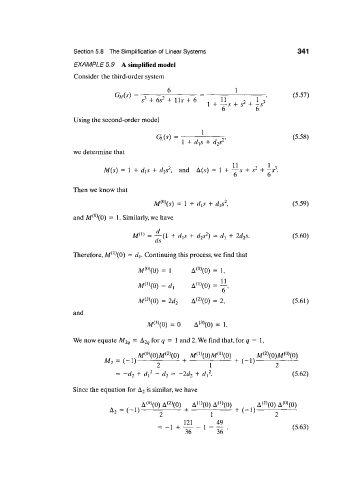
                        EXAMPLE  5.9  A simplified  model
                        Consider the third-order  system

                                    G 5                        =                 -          5 57
                                     "<>   =  w ^ n        XA    — r r ^        r -        <- >
                                            r  +  6.r  +  11,+6     U   +  ^  +  1  ,
                        Using the second-order  model


                                                         1  +  d\S  +  d 2S
                       we determine  that

                                                                        11         1
                                                    2
                                 M(s)  =  1 +  d hs  +  d 2s ,  and  A(.y)  =  1 +  —  .v +  s 2  +  -s\
                                                                        6          6
                       Then  we know  that
                                                                     2
                                                  (0)
                                                M (s)  =  1 +  rfj*  +  ^- ,              (5.59)
                             (0)
                       and  M (0)  =  1. Similarly, we  have
                                            !                  2
                                         M<>  =  —  (1  + rf,.y +  d 2s )  =  </,  +  2d 2s.  (5.60)
                                                as
                                   (l
                       Therefore, M ^(0)  =  d h  Continuing this process, we find  that
                                                             (0)
                                             (0)
                                           M (0)  =  1     A (0)  =  1,
                                                             (l)
                                             (1)
                                           M (0)  =  d A   A (0)  =  -^-,
                                                                     6
                                                             (2)
                                             (2)
                                           M (0)  =  2d 2  A (0)  =  2,                   (5.61)
                       and
                                                              (3)
                                                (3)
                                              M (0)  =  0   A (0)  =  1.
                       We now equate  M 2q  =  A 2q  for  q  =  1 and  2. We find  that, for  q  =  1,
                                                                   (1)
                                                             (1)
                                                                                        (0)
                                                                                 (2)
                                             (0)
                                                   (2)
                                           M (0)M (0)      M (0)M (0)           M (0)M (0)
                                                                           (
                                       (
                                 M 2  = -1)    ^     ^   +     ^     ^   + -1)     ^       ^
                                               2                2
                                    =  -rf 2  +  a",  -  d 2  =  -2d 2  +  d x .          (5.62)
                       Since the equation  for  A 2 is similar, we have
                                                                                (2)    (())
                                            A(Q)( 0)  A(2)( 0)  A (i)( 0) d) ( 0 )  ^  A (0)  A (0)
                                                                  A

