


Page 207 - Modern Derivatization Methods for Separation Sciences
P. 207
Document                                                                                Página 1 de 2


                                                                                                          Page 95


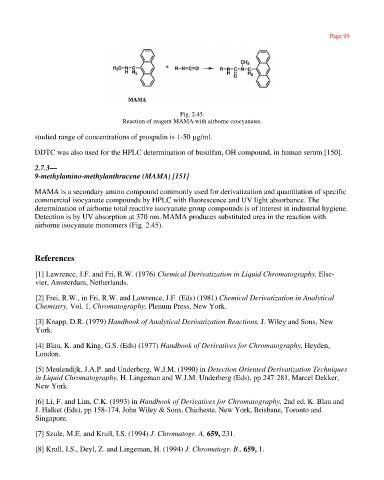
                                                          Fig. 2.45.
                                        Reaction of reagent MAMA with airborne csocyanates.

            studied range of concentrations of prospidin is 1-50 µg/ml.

            DDTC was also used for the HPLC determination of busulfan, OH compound, in human serum [150].

            2.7.3—
            9-methylamino-methylanthracene (MAMA) [151]

            MAMA is a secondary amino compound commonly used for derivatization and quantitation of specific
            commercial isocyanate compounds by HPLC with fluorescence and UV light absorbance. The
            determination of airborne total reactive isocyanate group compounds is of interest in industrial hygiene.
            Detection is by UV absorption at 370 nm. MAMA produces substituted urea in the reaction with
            airborne isocyanate monomers (Fig. 2.45).


            References


            [1] Lawrence, J.F. and Fri, R.W. (1976) Chemical Derivatization in Liquid Chromatography, Else-
            vier, Amsterdam, Netherlands.

            [2] Frei, R.W., in Fri, R.W. and Lawrence, J.F. (Eds) (1981) Chemical Derivatization in Analytical
            Chemistry, Vol. 1, Chromatography, Plenum Press, New York.

            [3] Knapp, D.R. (1979) Handbook of Analytical Derivatization Reactions, J. Wiley and Sons, New
            York.

            [4] Blau, K. and King, G.S. (Eds) (1977) Handbook of Derivatives for Chromatography, Heyden,
            London.

            [5] Meulendijk, J.A.P. and Underberg, W.J.M. (1990) in Detection Oriented Derivatization Techniques
            in Liquid Chromatography, H. Lingeman and W.J.M. Underberg (Eds), pp 247-281, Marcel Dekker,
            New York.

            [6] Li, F. and Lim, C.K. (1993) in Handbook of Derivatives for Chromatography, 2nd ed, K. Blau and
            J. Halket (Eds), pp 158-174, John Wiley & Sons, Chicheste, New York, Brisbane, Toronto and
            Singapore.

            [7] Szule, M.E. and Krull, I.S. (1994) J. Chromatogr. A, 659, 231.

            [8] Krull, I.S., Deyl, Z. and Lingeman, H. (1994) J. Chromatogr. B., 659, 1.


            http://emedia.netlibrary.com/nlreader/nlreader.dll?bookid=17968&filename=Page_95.html     30/09/2003

