


Page 205 - Modern Derivatization Methods for Separation Sciences
P. 205
Document                                                                                Página 1 de 2


                                                                                                          Page 94


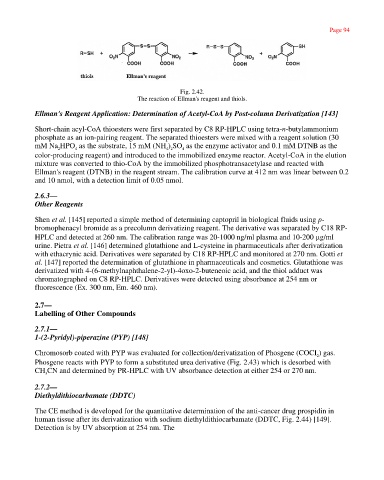
                                                          Fig. 2.42.
                                             The reaction of Ellman's reagent and thiols.

            Ellman's Reagent Application: Determination of Acetyl-CoA by Post-column Derivatization [143]

            Short-chain acyl-CoA thioesters were first separated by C8 RP-HPLC using tetra-n-butylammonium
            phosphate as an ion-pairing reagent. The separated thioesters were mixed with a reagent solution (30
            mM Na HPO  as the substrate, 15 mM (NH ) SO  as the enzyme activator and 0.1 mM DTNB as the
                    2
                                                      4 2
                         4
                                                           4
            color-producing reagent) and introduced to the immobilized enzyme reactor. Acetyl-CoA in the elution
            mixture was converted to thio-CoA by the immobilized phosphotransacetylase and reacted with
            Ellman's reagent (DTNB) in the reagent stream. The calibration curve at 412 nm was linear between 0.2
            and 10 nmol, with a detection limit of 0.05 nmol.
            2.6.3—
            Other Reagents

            Shen et al. [145] reported a simple method of determining captopril in biological fluids using p-
            bromophenacyl bromide as a precolumn derivatizing reagent. The derivative was separated by C18 RP-
            HPLC and detected at 260 nm. The calibration range was 20-1000 ng/ml plasma and 10-200 µg/ml
            urine. Pietra et al. [146] determined glutathione and L-cysteine in pharmaceuticals after derivatization
            with ethacrynic acid. Derivatives were separated by C18 RP-HPLC and monitored at 270 nm. Gotti et
            al. [147] reported the determination of glutathione in pharmaceuticals and cosmetics. Glutathione was
            derivatized with 4-(6-methylnaphthalene-2-yl)-4oxo-2-buteneoic acid, and the thiol adduct was
            chromatographed on C8 RP-HPLC. Derivatives were detected using absorbance at 254 nm or
            fluorescence (Ex. 300 nm, Em. 460 nm).


            2.7—
            Labelling of Other Compounds

            2.7.1—
            1-(2-Pyridyl)-piperazine (PYP) [148]

            Chromosorb coated with PYP was evaluated for collection/derivatization of Phosgene (COCI ) gas.
                                                                                                      2
            Phosgene reacts with PYP to form a substituted urea derivative (Fig. 2.43) which is desorbed with
            CH CN and determined by PR-HPLC with UV absorbance detection at either 254 or 270 nm.
               3
            2.7.2—
            Diethyldithiocarbamate (DDTC)

            The CE method is developed for the quantitative determination of the anti-cancer drug prospidin in
            human tissue after its derivatization with sodium diethyldithiocarbamate (DDTC, Fig. 2.44) [149].
            Detection is by UV absorption at 254 nm. The


            http://emedia.netlibrary.com/nlreader/nlreader.dll?bookid=17968&filename=Page_94.html     30/09/2003

