


Page 246 - Modern Derivatization Methods for Separation Sciences
P. 246
Document                                                                                Página 1 de 2


                                                                                                         Page 114


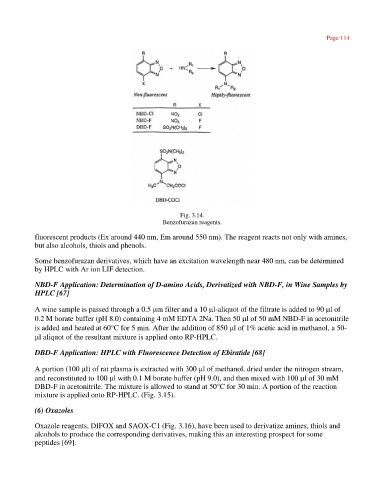
                                                          Fig. 3.14.
                                                     Benzofurazan reagents.

            fluorescent products (Ex around 440 nm, Em around 550 nm). The reagent reacts not only with amines,
            but also alcohols, thiols and phenols.

            Some benzofurazan derivatives, which have an excitation wavelength near 480 nm, can be determined
            by HPLC with Ar ion LIF detection.

            NBD-F Application: Determination of D-amino Acids, Derivatized with NBD-F, in Wine Samples by
            HPLC [67]

            A wine sample is passed through a 0.5 µm filter and a 10 µl-aliquot of the filtrate is added to 90 µl of
            0.2 M borate buffer (pH 8.0) containing 4 mM EDTA 2Na. Then 50 µl of 50 mM NBD-F in acetonitrile
            is added and heated at 60°C for 5 min. After the addition of 850 µl of 1% acetic acid in methanol, a 50-
            µl aliquot of the resultant mixture is applied onto RP-HPLC.

            DBD-F Application: HPLC with Fluorescence Detection of Ebiratide [68]

            A portion (100 µl) of rat plasma is extracted with 300 µl of methanol, dried under the nitrogen stream,
            and reconstituted to 100 µl with 0.1 M borate buffer (pH 9.0), and then mixed with 100 µl of 30 mM
            DBD-F in acetonitrile. The mixture is allowed to stand at 50°C for 30 min. A portion of the reaction
            mixture is applied onto RP-HPLC. (Fig. 3.15).

            (6) Oxazoles

            Oxazole reagents, DIFOX and SAOX-C1 (Fig. 3.16), have been used to derivatize amines, thiols and
            alcohols to produce the corresponding derivatives, making this an interesting prospect for some
            peptides [69].


            http://emedia.netlibrary.com/nlreader/nlreader.dll?bookid=17968&filename=Page_114.ht...   30/09/2003

