


Page 241 - Modern Derivatization Methods for Separation Sciences
P. 241
Document                                                                                Página 1 de 2


                                                                                                         Page 111

            General Derivatization Procedure of Amines with BHBT-COF

            To 100 µl of a test solution of amines in acetonitrile are added 100 µl of 10 mM quinuclidine in
            acetonitrile and 100 µl of 3 mM BHBT-COF in acetonitrile. The mixture is allowed to stand at 37°C for
            20 min, then a portion (20 µl) is subjected to RP-HPLC. The fluorescence intensity is monitored with
            excitation at 350 nm and emission at 450 nm. The detection limits for primary and secondary amines
            are about 3 and 30 fmol, respectively, on-column. Fig. 3.7B shows a typical chromatogram of BHBT
            derivatives of some amines.

            DMEQ-COCI Application: HPLC Determination of β       -phenylethylamine in Human Plasma [47]

            A 1.0 ml aliquot of plasma is mixed with 50 µl of p-methylbenzylamine (MBA, IS) and 0.5 ml of 70
            mM HCl and the mixture is poured into a Toyopak SP cartridge. The cartridge is washed successively
            with 5 ml of water (twice) and 1.8 ml of aqueous 40% acetonitrile (twice). The adsorbed amines are
            eluted with 3 ml of a mixture of acetonitrile and 1.0 M NaCl (2:3, v/v). To the eluate, 0.6 ml of 0.5 M
            NaOH and 6 ml of ethyl acetate are added. Phenylethylamine and MBA are extracted by shaking for 10
            min. The organic layer (about 6 ml) is evaporated to dryness in vacuo at 50°C and the residue is
            dissolved in 200 µl of acetonitrile containing 2.0% Triton X-405. To the solution, 100 µl of 2 mM
            DMEQ-COCI in acetonitrile and about 3 mg of K CO  are added. The mixture is allowed to stand at
                                                                3
                                                            2
            room temperature for about 1 min. The supernatant (20 µl) of the final reaction mixture is applied onto
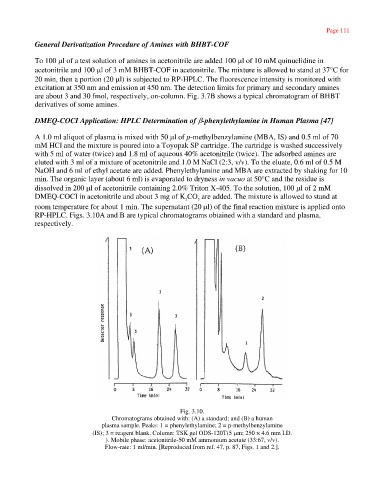
            RP-HPLC. Figs. 3.10A and B are typical chromatograms obtained with a standard and plasma,
            respectively.


                                                          Fig. 3.10.
                                     Chromatograms obtained with: (A) a standard; and (B) a human
                                 plasma sample. Peaks: 1 = phenylethylamine; 2 = p-methylbenzylamine
                              (IS); 3 = reagent blank. Column: TSK gel ODS-120T(5 µm; 250 × 4.6 mm I.D.
                                   ). Mobile phase: acetonitrile-50 mM ammonium acetate (33:67, v/v).
                                  Flow-rate: 1 ml/min. [Reproduced from ref. 47, p. 87, Figs. 1 and 2.].


            http://emedia.netlibrary.com/nlreader/nlreader.dll?bookid=17968&filename=Page_111.ht...   30/09/2003

