


Page 180 - Modern physical chemistry
P. 180
172                       Equilibria in Condensed Phases

                Each of these procedures involves a different k i  in equation (7.42), a different pOi in
             formula (8.2), and so a different standard state. But for anyone of these choices, a person
             can construct equation (7.52) for AG, set it equal to zero as in equation (7.54), and obtain
             the conventional form for the equilibrium constant (7.57).

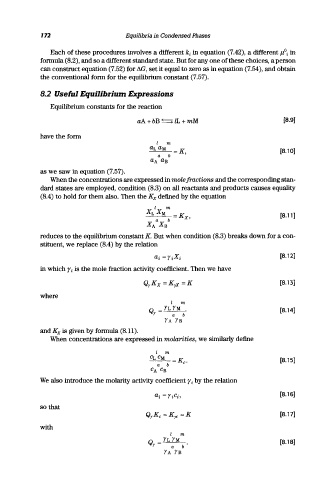
             8.2  Useful Equilibrium Expressions
                Equilibrium constants for the reaction

                                          aA + bB (  ) lL + mM                        [8.9J

             have the form

                                                                                     [8.lOJ

             as we saw in equation (7.57).
                When the concentrations are expressed in mole fractions and the corresponding stan-
             dard states are employed, condition (8.3) on all reactants and products causes equality
             (8.4) to hold for them also. Then the Kx defined by the equation
                                               I   m
                                             XL  X M   _  K                          [8.11 J
                                                a   b  -  X,
                                             X A  X B
             reduces to the equilibrium constant K. But when condition (8.3) breaks down for a con-
             stituent, we replace (8.4) by the relation

                                               ai =YiXi                              [8.12J
             in which ri is the mole fraction activity coefficient. Then we have
                                                                                     [8.13J

             where
                                                    I   m
                                              Q  = YL  YM                            [8.14J
                                               Y     a   b
                                                  YA  YB
             and Kx is given by formula (8.11).
                When concentrations are expressed in molarities, we similarly define

                                                I   m
                                              CL  CM   -K                            [8.15J
                                                a   b  -  c·
                                              CA  CB
             We also introduce the molarity activity coefficient ri by the relation
                                                                                     [8.16J

             so that
                                                                                     [8.17J
             with
                                                    I   m
                                             Q  = YL  YM                             [8.18J
                                               Y    a   b'
                                                  YA  YB

